Tog & þel is what makes the wool of Icelandic sheep unique.
The fibres of tog are long, relatively coarse and strong — water repellent and protective.
& The fibres of þel are short, fine and soft — fluffy to trap lots of warm air within.
In the heart of the Kvennaskólinn, under the tutelage of history,
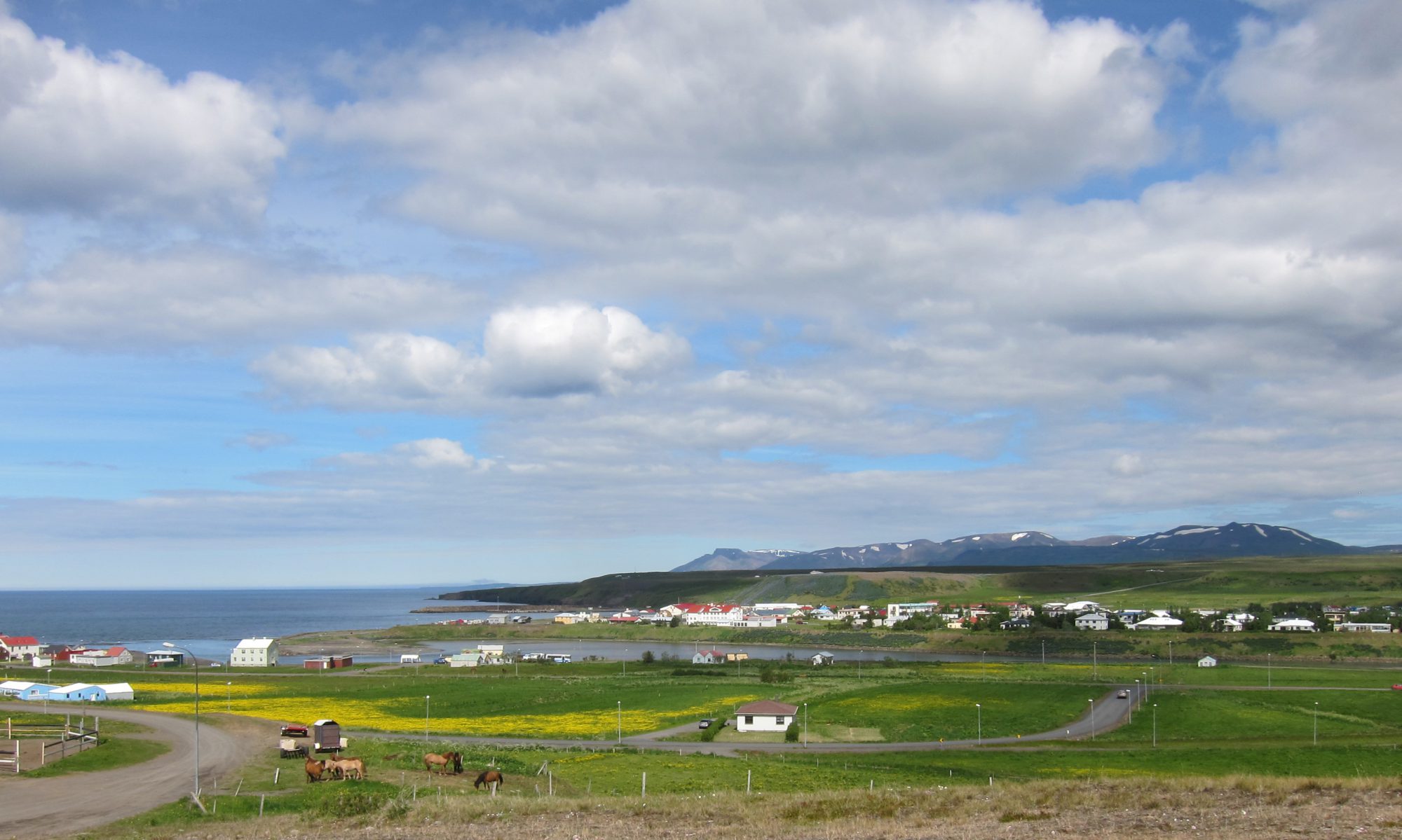
By the shores of the River Blanda’s estuary,
Infused with the sounds of the surf, the wind and the migrating birds,
An interdisciplinary group of Canadian students is woven together: wool, wonder and wild plants.
Sixteen artists translate impressions of local landscape and ecology, culture and tradition, in a call-and-response with the living land, sea and sky.
Blönduós has welcomed us. We have walked and foraged her shores and hills with awe and gratitude. We have filmed, photographed and felted. We have sewn, painted, swum and steamed.
Our diverse disciplines — geography, anthropology, ceramics, fibre arts, film production and art education — have converged. We have learned from one another, from our teachers at the Icelandic Textile Center, and from the contrasts contained within the materials unique to this place: tog and þel, black sand and white agate, fire and ice.
Thank you for having us
Takk fyrir okkur
Andre Bastian Ibarguengoitia, Lucy Carver-Brennan, Shan Collar, Elizabeth Dovolis, Annabel Durr, Melanie Garcia, Ariana G. Hipsagh, Hannah Jakob, Zoé Lapostolle, Keyiana Marques, Rowan McKellar, Shannon Pot, Genevieve Prefontaine, Émilie Valiquette, Ginger Weissdown, Jennifer Wiebe
Field School Leader: Dr. Kathleen Vaughan
Instructors in Iceland:
Jóhanna Erla Pálmadóttir/Spinning
Ragnheiður Björk Þórsdóttir/Weaving and Tapestry
Þorgerður Hlöðversdóttir/Natural Dye Methods
Sarah Finkle and Alissa Estivariz/Bio Materials
tog & þel
Tog & þel er það sem gerir ull íslensku sauðkindarinnar einstaka. Þræðir torgsins eru langir, tiltölulega grófir og sterkir — hrinda frá sér vatni og eru verndandi & þræðir Þelsins eru stuttir fíngerðir og mjúkir — dúnmjúkir til að fanga gnægð hlýs lofts.
Í hjarta Kvennaskólans, undir handleiðslu sögunnar, Við strendur óss Blöndu, undir áhrifum frá hljómum brimsins, vindsins og farfuglanna, fléttast saman þverfaglegur hópur kanadískra nemenda: ull, undur og villtar jurtir.
Sextán listamenn túlka hughrif af landslagi staðarins, vistkerfi, menningu og hefðir, í kalli sem bergmálar lifandi land, haf og himinn.
Blönduós hefur tekið vel á móti okkur. Við höfum gengið um strendur staðarins, hæðir og leitað fanga úr náttúrunni af lotningu og þakklæti. Við höfum kvikmyndað, ljósmyndað og þæft. Við höfum saumað, málað, synt og farið í gufu. Fjölbreyttar fræðigreinar okkar — landafræði, mannfræði, keramík, textíllist, kvikmyndagerð og listkennsla — hafa runnið saman í eitt. Við höfum lært hvert af öðru, af kennurum okkar hjá Textílmiðstöð Íslands, og af þeim andstæðum sem búa í efniviðnum sem er einstakur fyrir þennan stað: togi og þeli, svörtum sandi og hvítum agat steinum, eldi og ís.
Takk fyrir okkur
Andre Bastian Ibarguengoitia, Lucy Carver-Brennan, Shan Collar, Elizabeth Dovolis, Annabel Durr, Melanie Garcia, Ariana G. Hipsagh, Hannah Jakob, Zoé Lapostolle, Keyiana Marques, Rowan McKellar, Shannon Pot, Genevieve Prefontaine, Émilie Valiquette, Ginger Weissdown, Jennifer Wiebe
Námstjóri vettvangsnáms: Dr. Kathleen Vaughan
Leiðbeinendur á Íslandi:
Jóhanna Erla Pálmadóttir/Spinning
Ragnheiður Björk Þórsdóttir/Weaving and Tapestry
Þorgerður Hlöðversdóttir/Natural Dye Methods
Sarah Finkle and Alissa Estivariz/Bio Materials
Curatorial Statement: Geneviève Préfontaine & Jennifer Wiebe, with Icelandic translation (Gemini) edited by Elsa Arnardóttir

Poster design: Hannah Jakob & Keyiana Marques
It is Saturday morning, June 27, 2026—stardate -296514.21588026395, our exhibition is today! The marking of this month of learning together in Blönduós cannot possibly be contained—our memories and photographs already refracting facets of crystal images (Deleuze, 1989) of this time. Installation preview here, with gratitude for this time, this place, these generous and creative souls.


References
Deleuze, G. (1989). Cinema 2: The time-image (H. Tomlinson & R. Galeta, Trans.). University of Minnesota Press.
