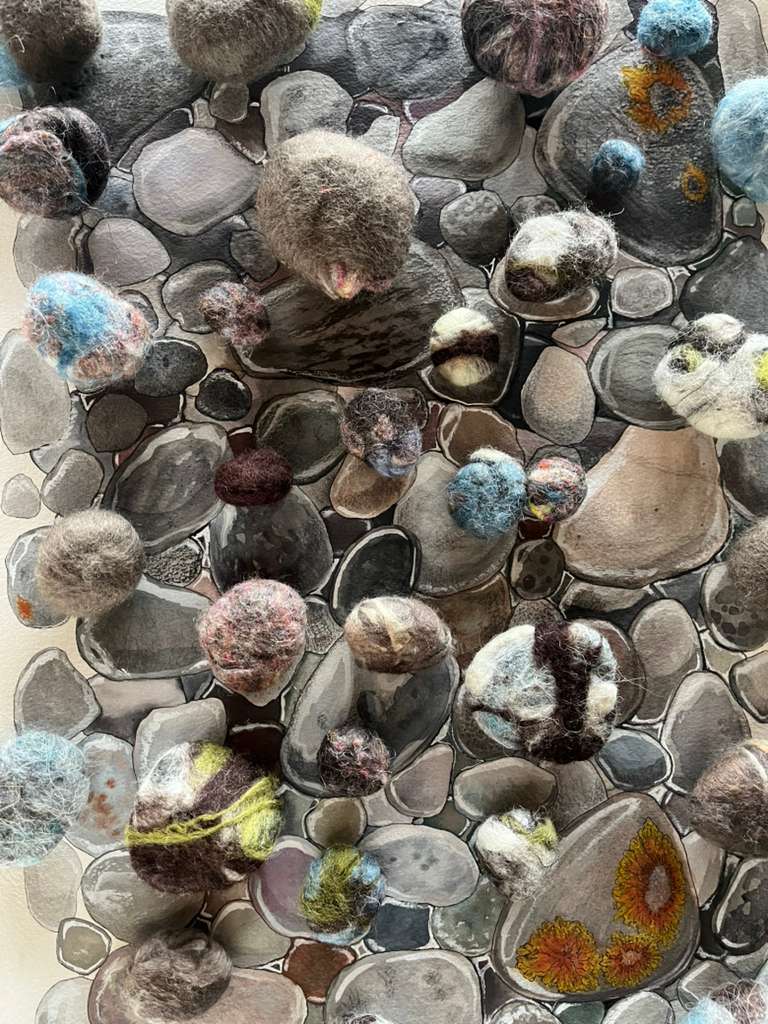
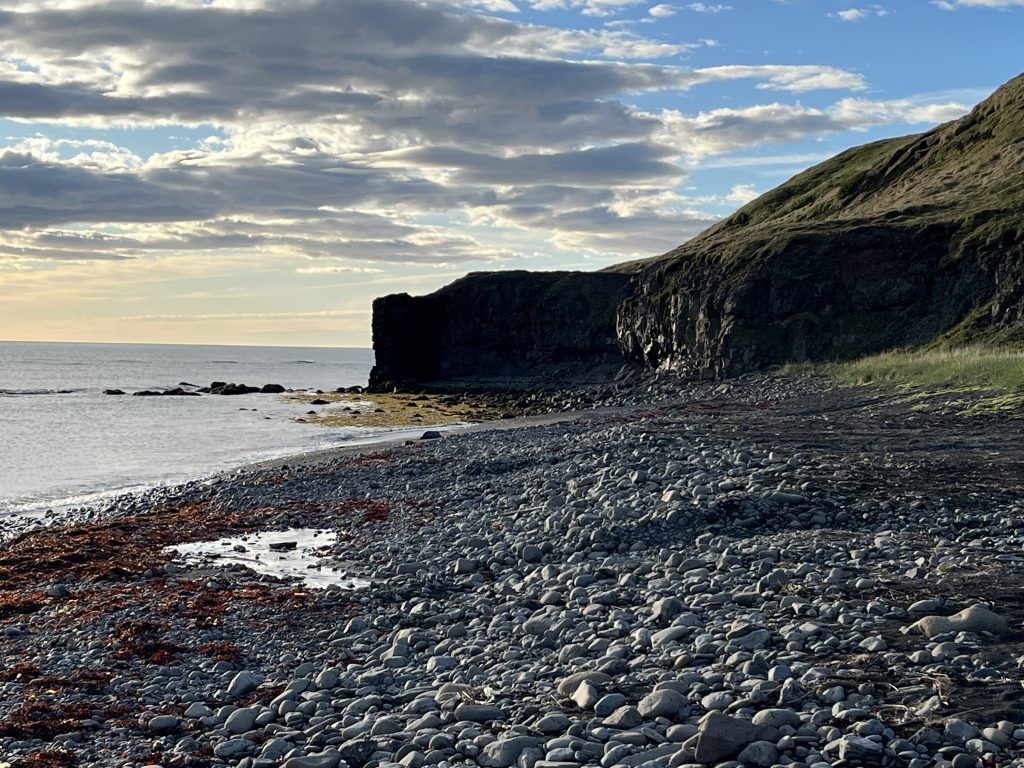
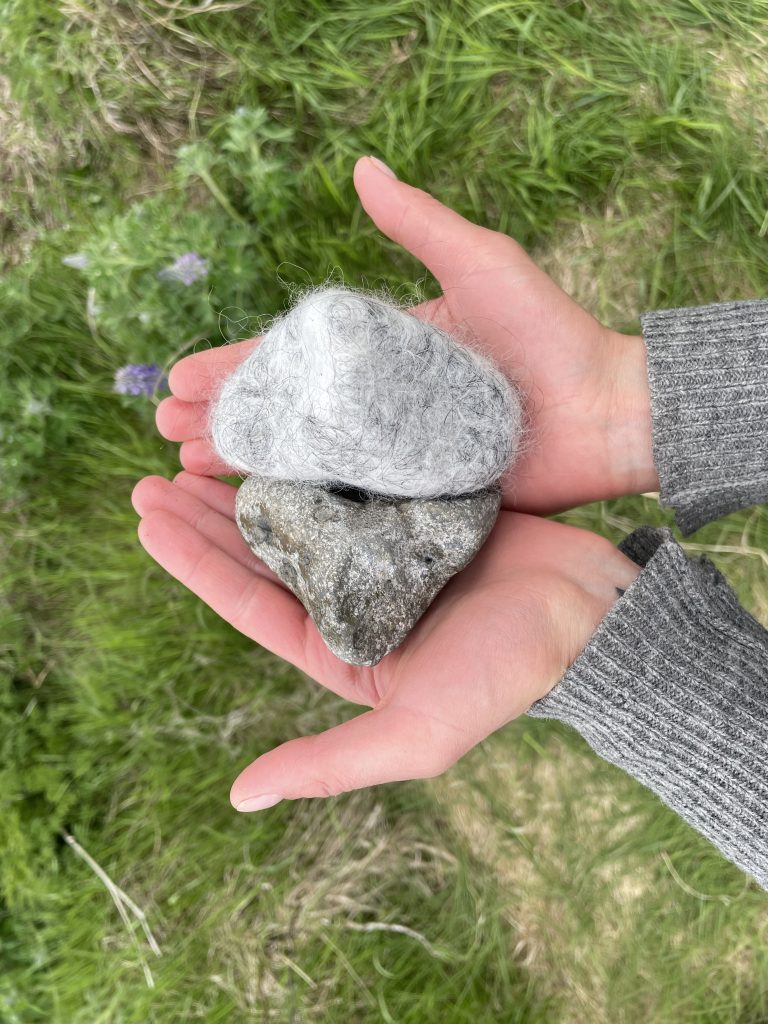
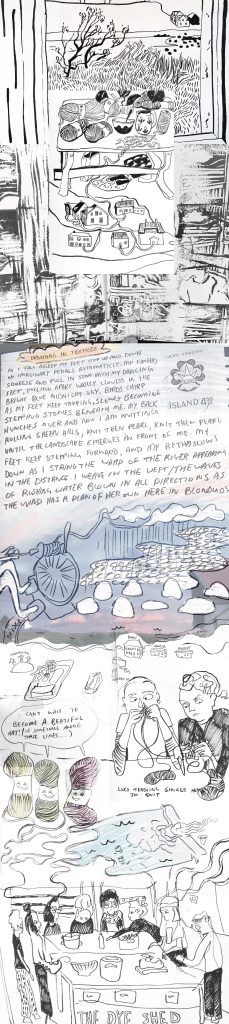
Long before I arrived at the Icelandic Textile Centre in Blönduós, I had a plan. I intended to observe the local mosses and flora, using wool and felting techniques to create botanical illustrations. The plants here are as exceptional as I expected, and they truly are a perfect match for the fiber. The issue is that I have found a new obsession—a completely different muse. I have fallen in love with the rocks. The beaches here are dominated by igneous lava rocks in beautiful shades of grey and black. Tucked inside them are agates, which form underground within the air pockets of ancient lava flows. Over time, water deposits silica into these pockets, creating opaque, glass-like structures. As the softer surrounding host rock erodes away, the resilient agate is left behind. I began by painting these beach stones using watercolor and gouache on paper, but I kept searching for a way to weave wool into the process. Just yesterday, I tried felting dimensional stones and placing them directly onto the painted surfaces. The result is awesome! Layering these felted wool rocks onto the flat paintings creates a multimedia piece with a really compelling depth, as seen in the attached image. With one week left before our final exhibition, I am eager to see where this momentum takes me.
I have been really attentive to the colors of the landscape and the colors of my newfound memories, in my focus on natural dyeing. I got really inspired by the lines of connection that formed in my mind between the colors of the sky and those coming from the ground.
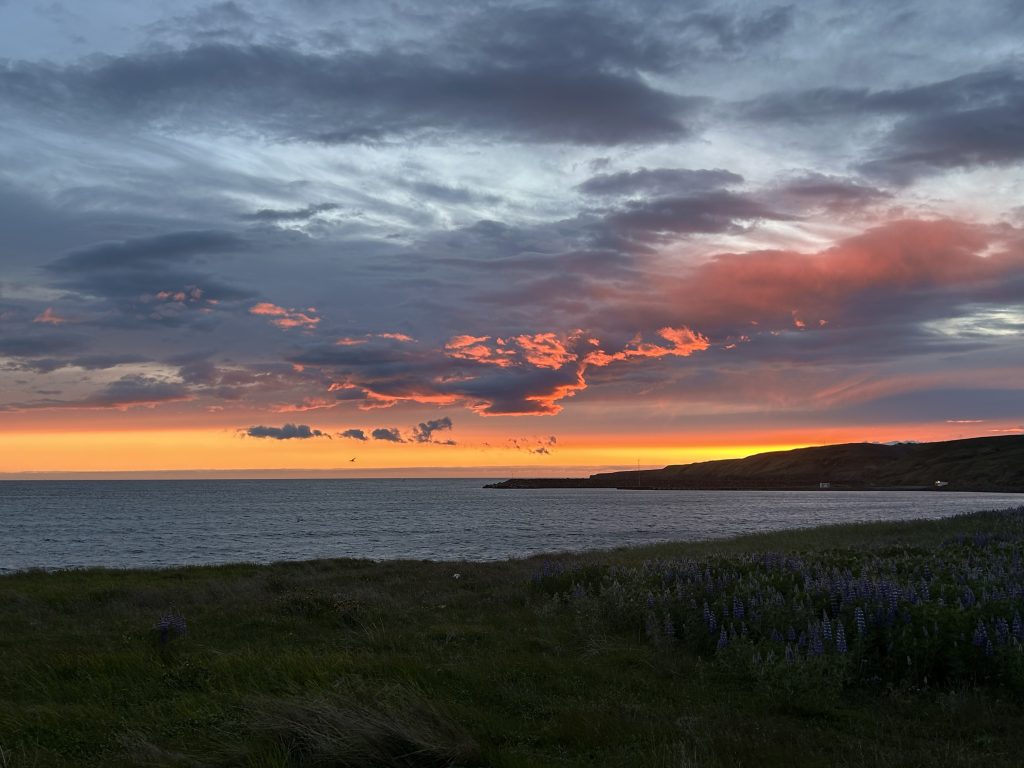
I was lucky enough to be awake at night in moments when the sky donned hues that brought tears to my eyes. Being very connected to the night sky at home, the midnight sun is bringing a whole new perspective to my connection to it. I realized that I don’t need to see the stars to feel small under them.
My impression of this experience is very colorful on all fronts.
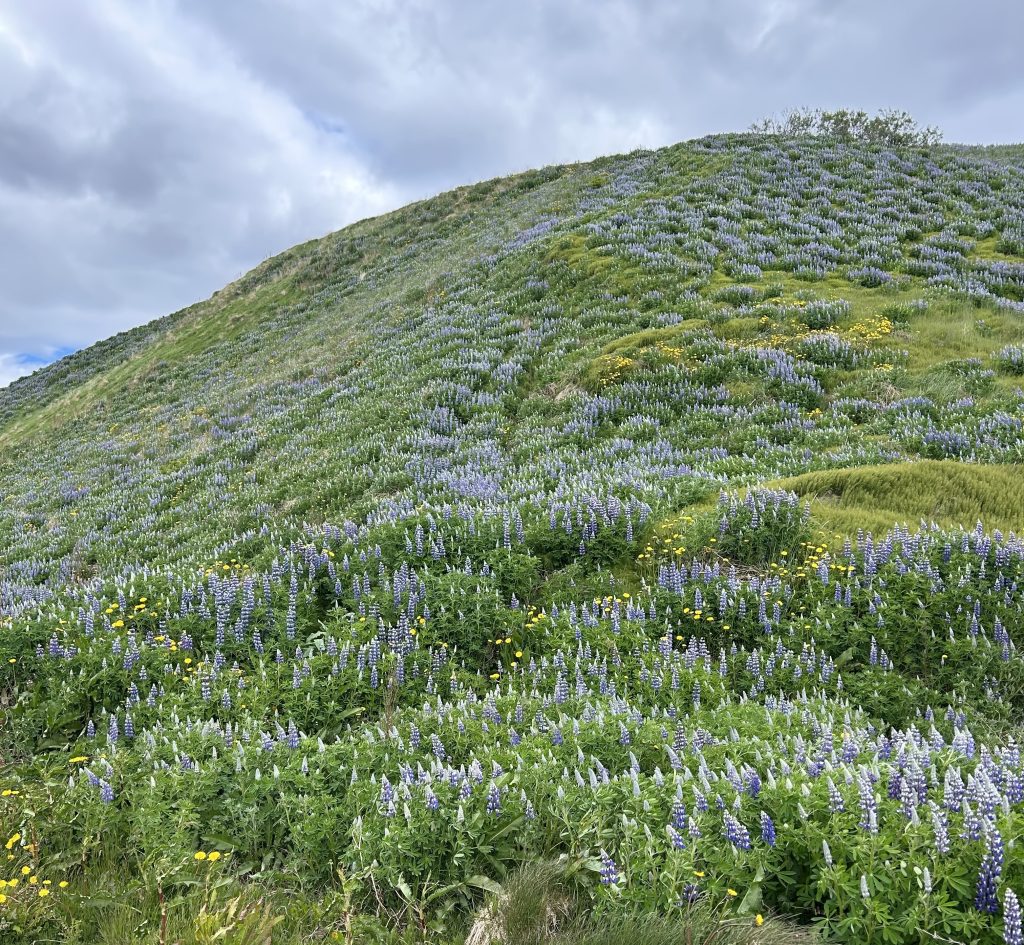
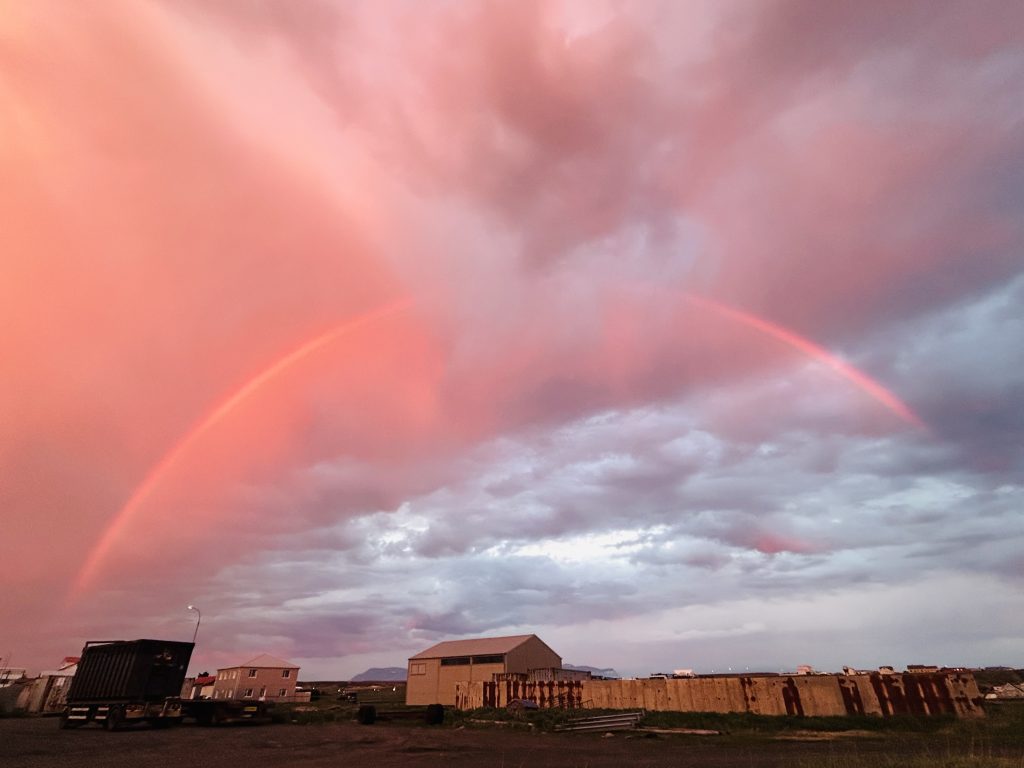
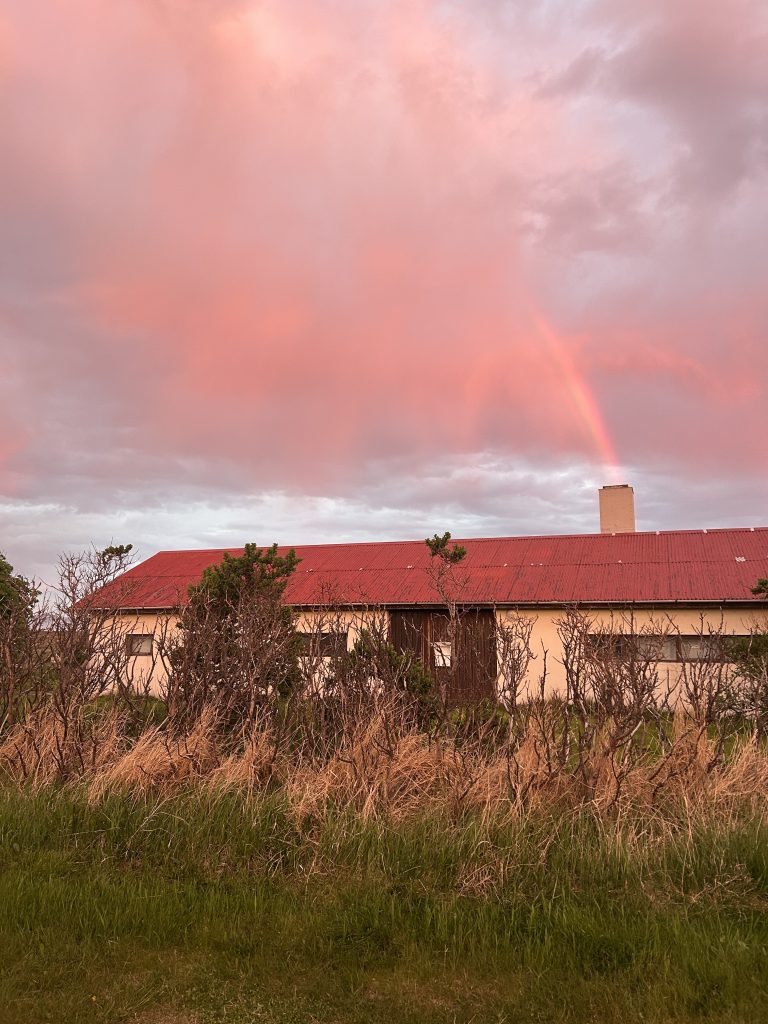
The landscapes, the striking pink-orange skies, purple lupins dancing with the wind alongside yellow marsh marigolds or dandelions. A rainbow crossing a sky split between pink and blue.
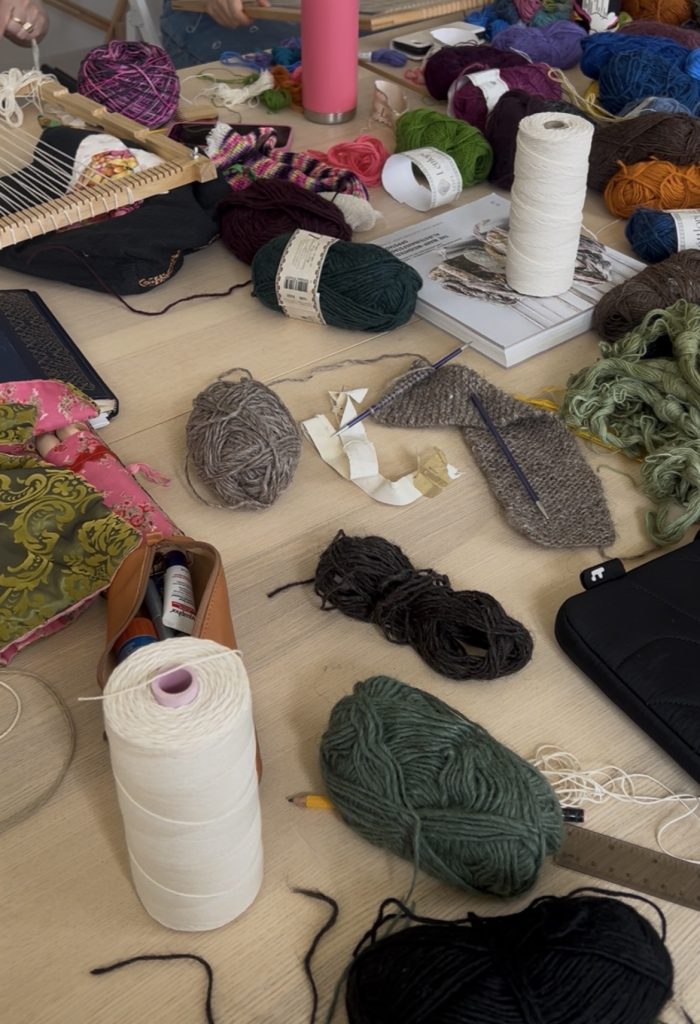
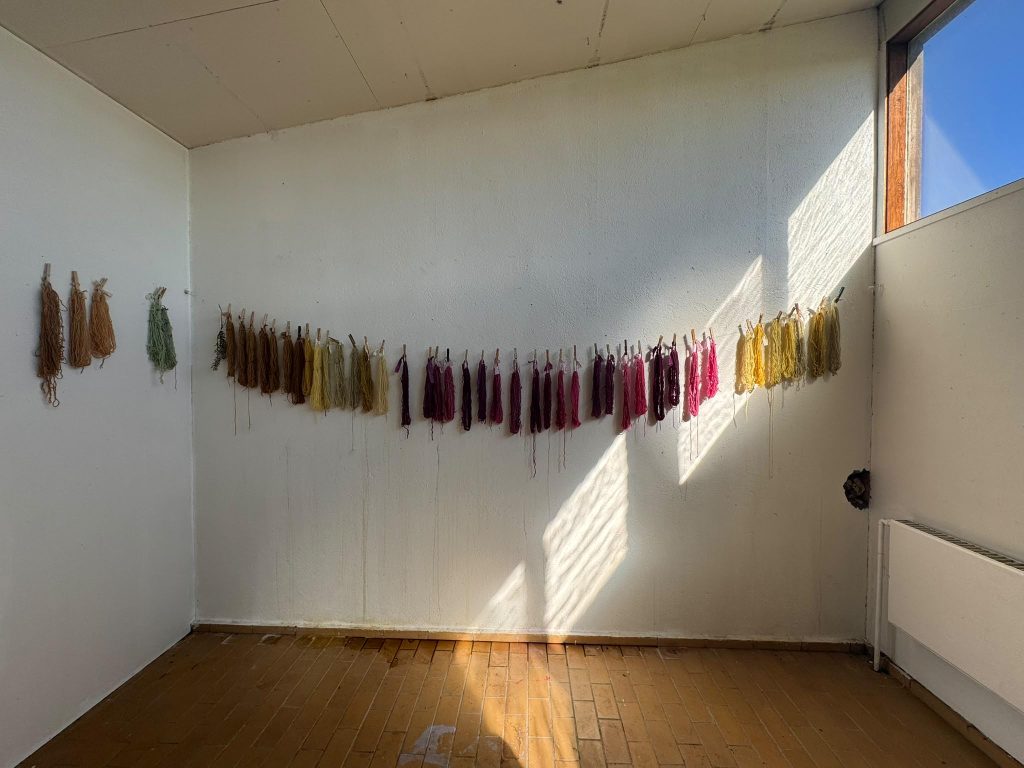
The classes, the wool, the textiles. A joyous multicolored sprawl of wool skeins on the table, waiting to be picked to be used in our tapestries. The skeins drying on the wall still dripping cochineal purples and lupin leaves, yellow after the natural dye workshop.
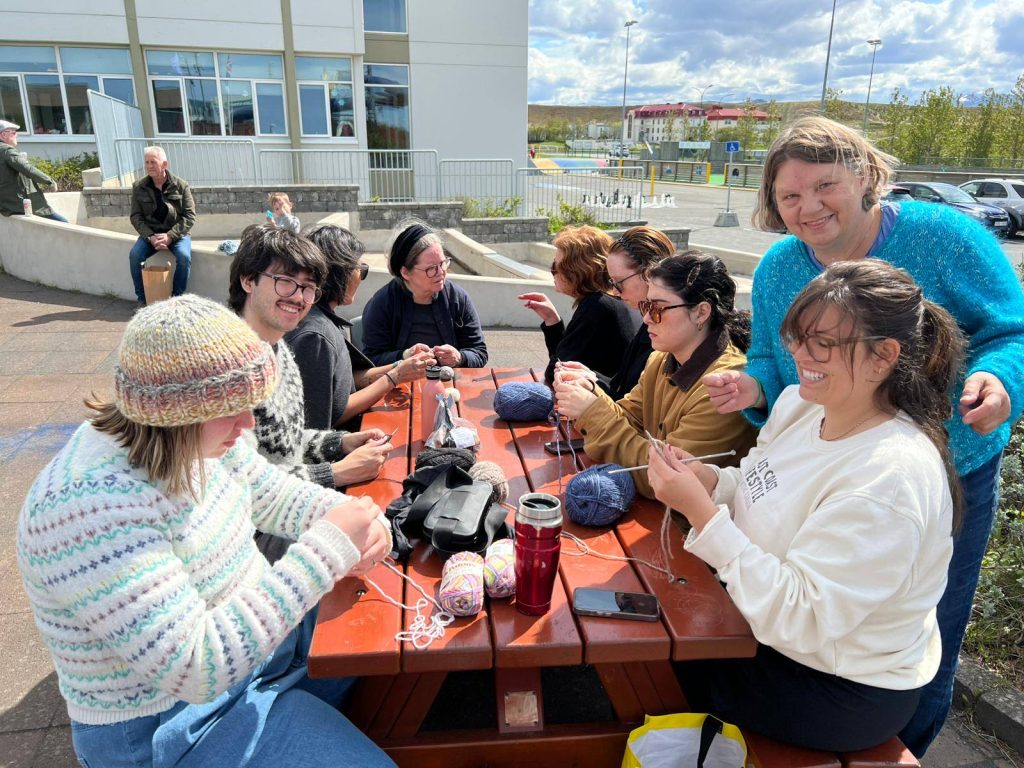
The very bright yellow shirt that Vika, from Reykjavik, was wearing when she taught me to knit. She was proud to say that she knitted with multiple types of yarn, because “there are no rules for knitting”.
The butter yellow of the Ömmukaffi, and its very charismatic owner, who serves delicious rhubarb waffles with a smile.
The blue of the pool on a sunny day, doing laps to start the day.
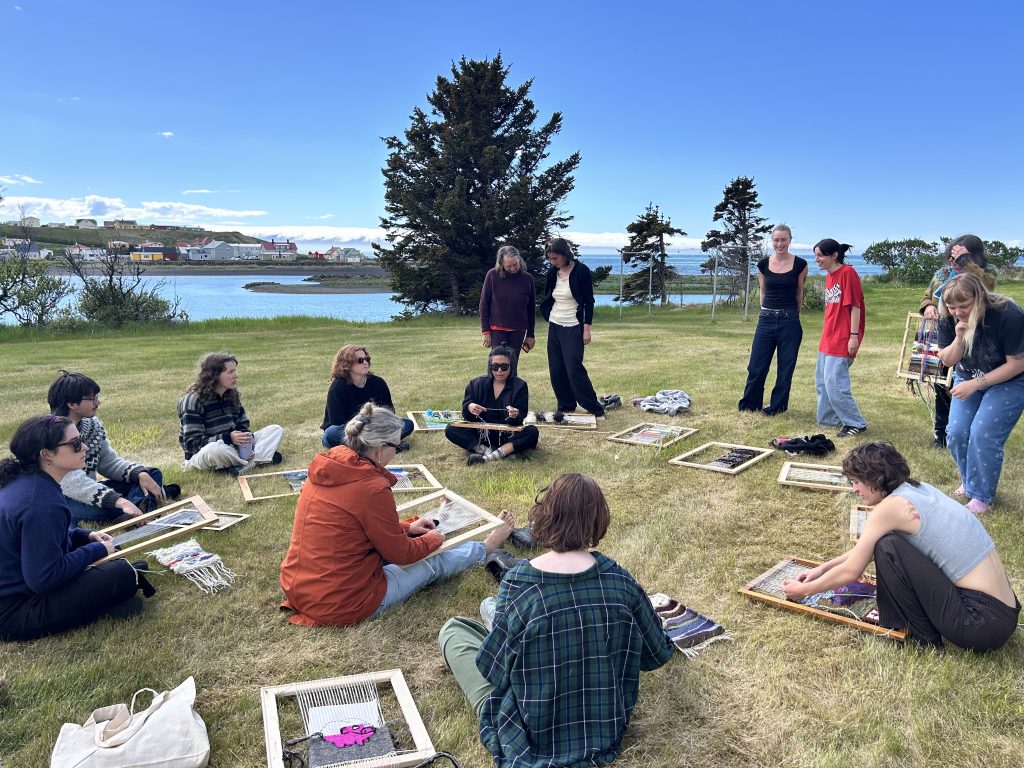
The green of the tall grasses we sat in to weave, to snack, to gaze out at the sea.
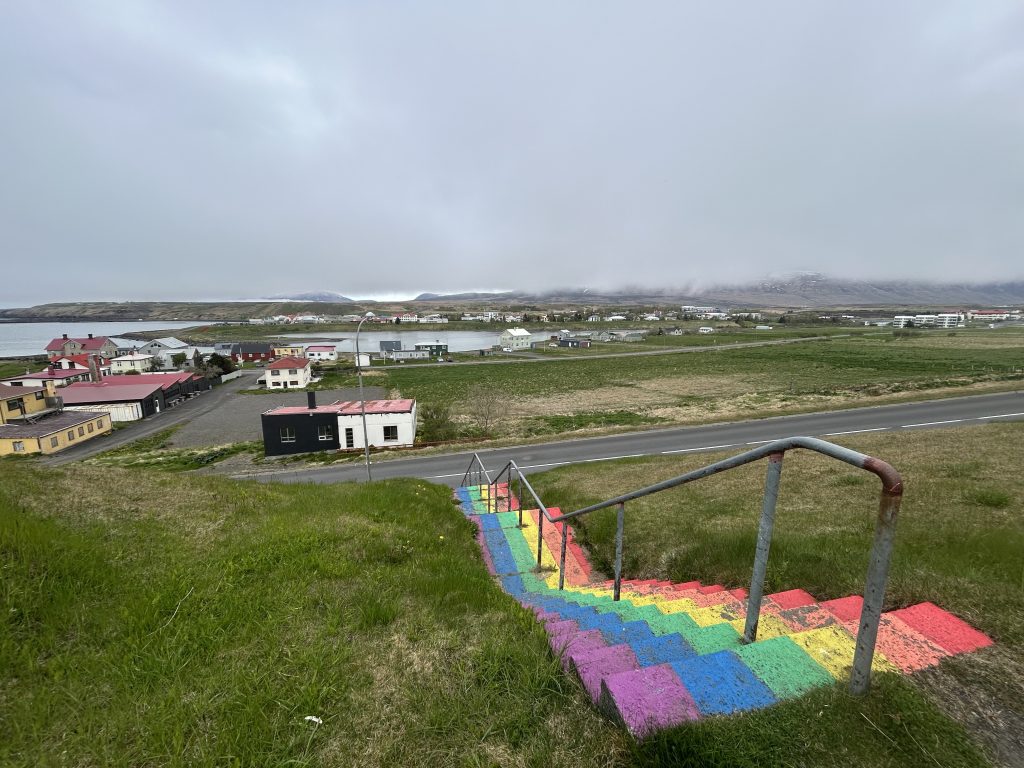
The red roofs. House 35 and the happy, creative impromptu meetings we have every night in the living room. The now familiar and comforting assortments of crafts living on the table.
All of that a very vibrant rainbow of creative moments with peers, new skills, breathtaking views, and new connections.
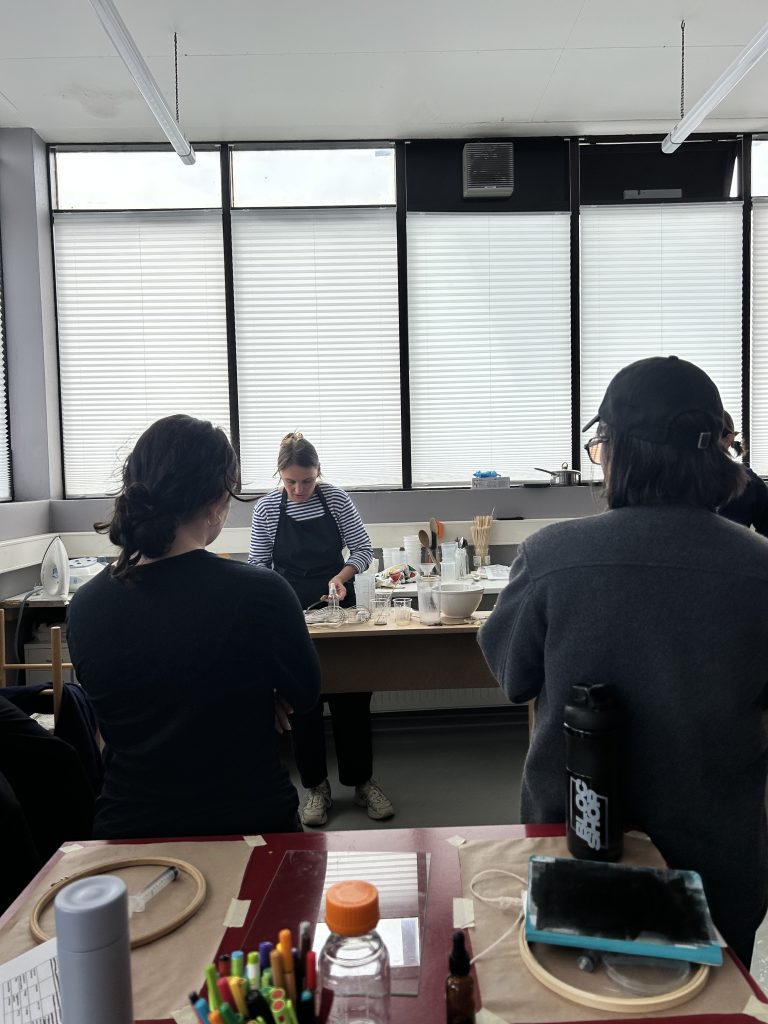
The first morning of our biomaterials workshop with Sarah and Alyssa began with a walk to the beach just to the north of the Textil Lab.
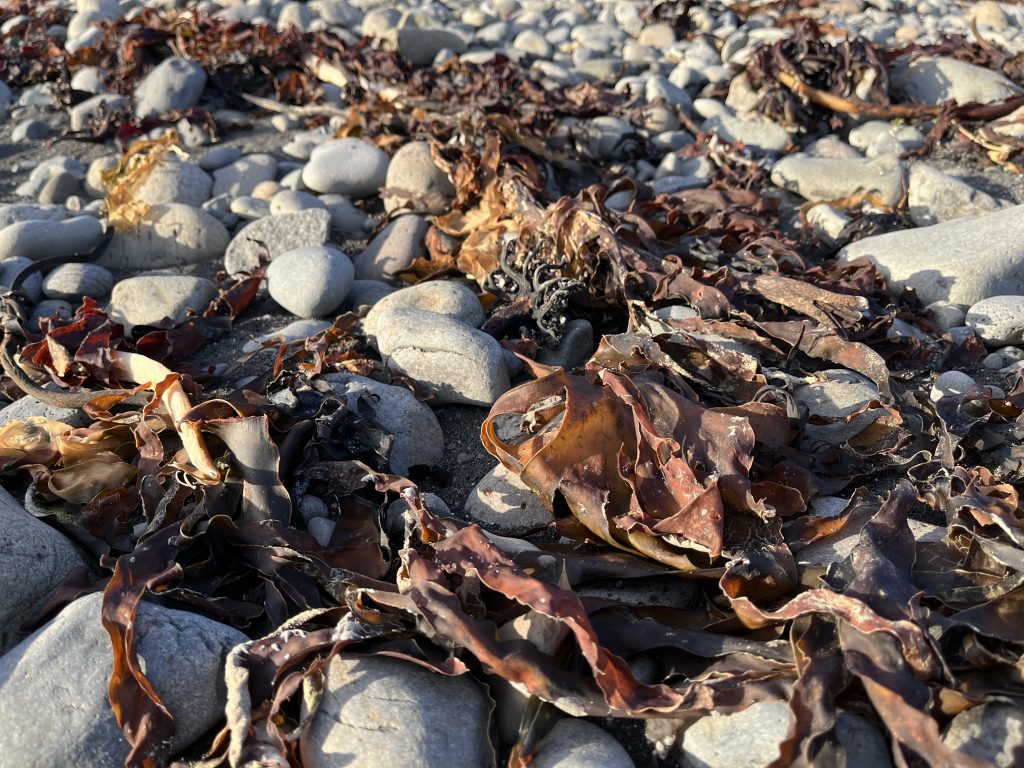
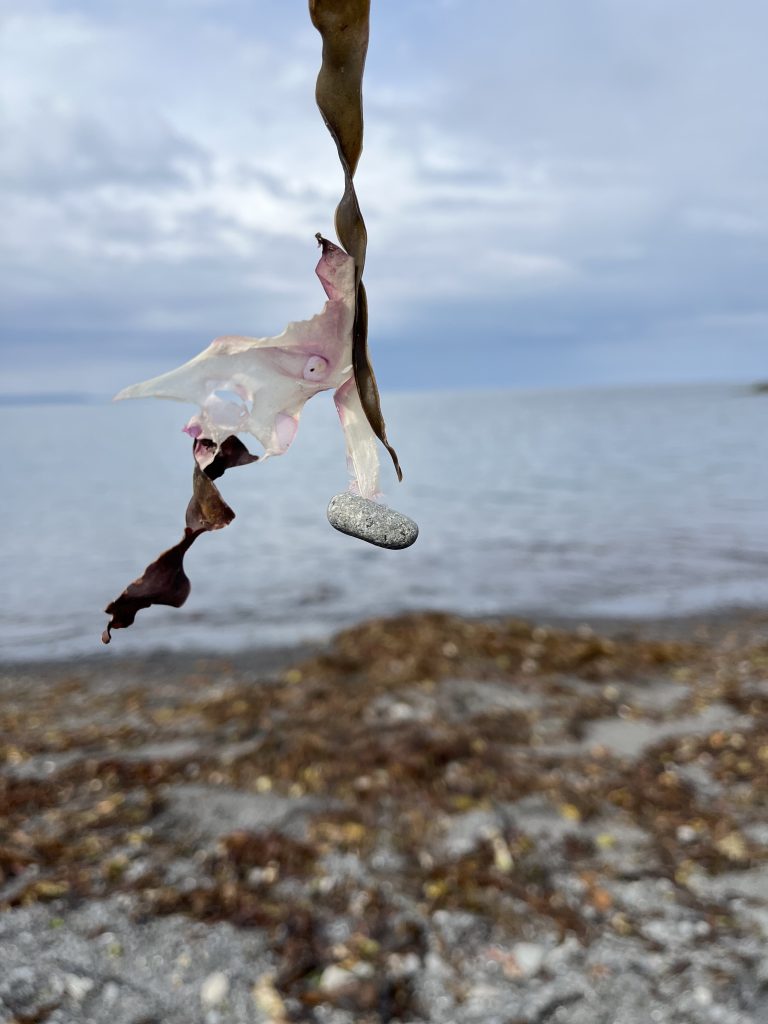
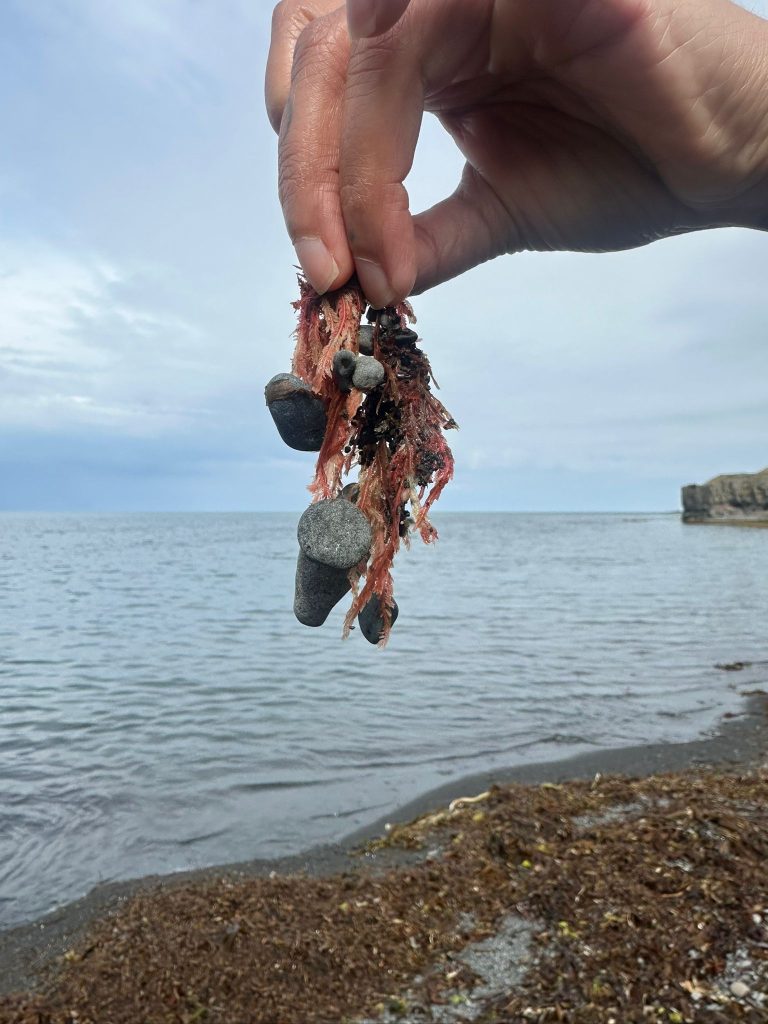
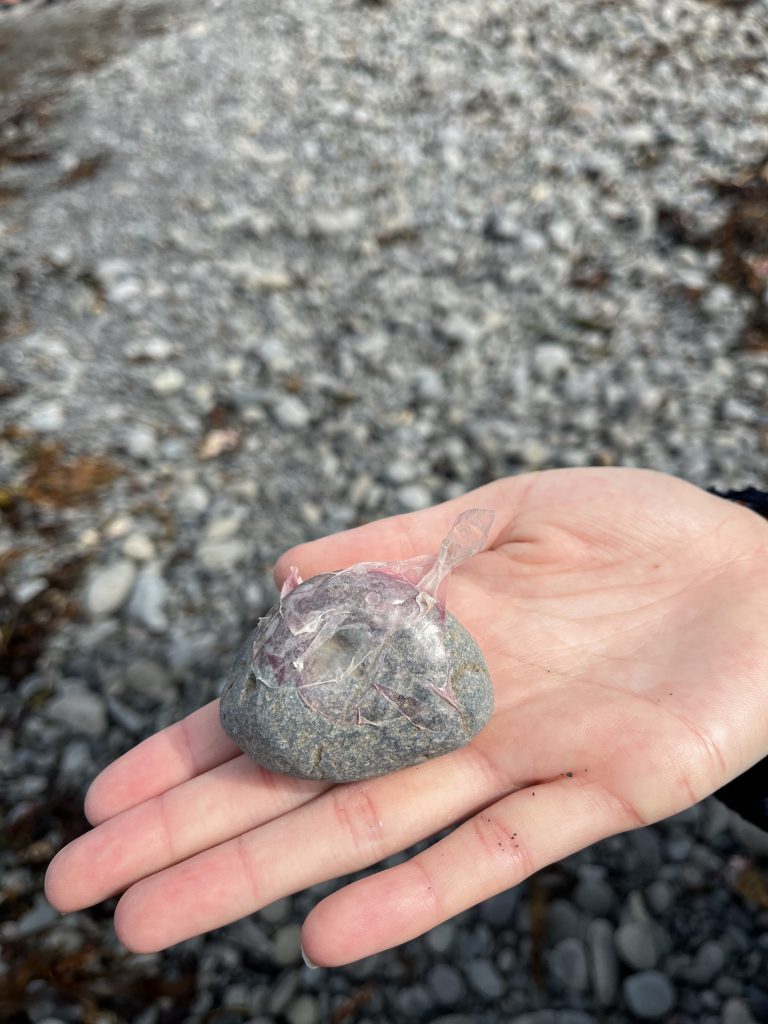
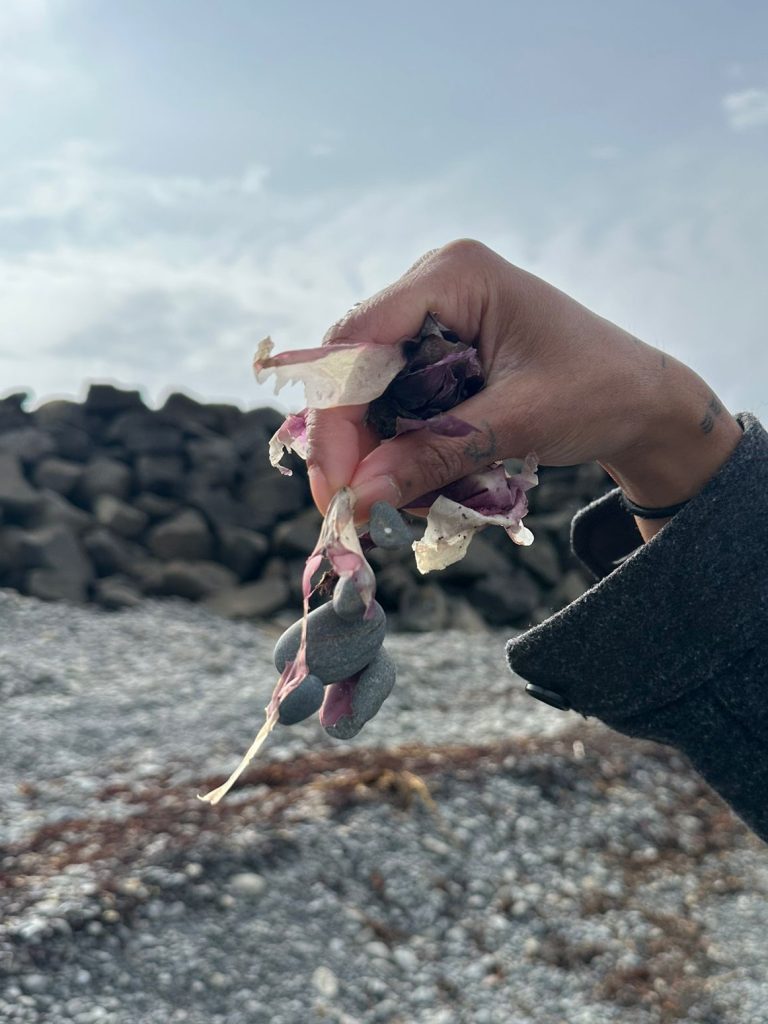
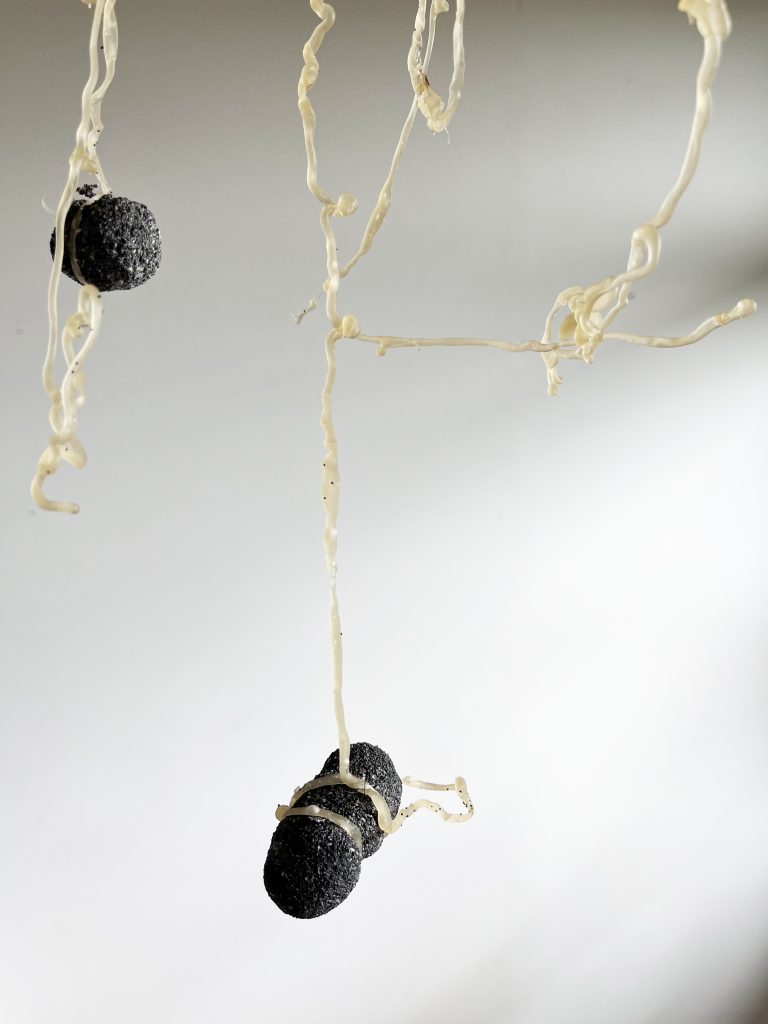
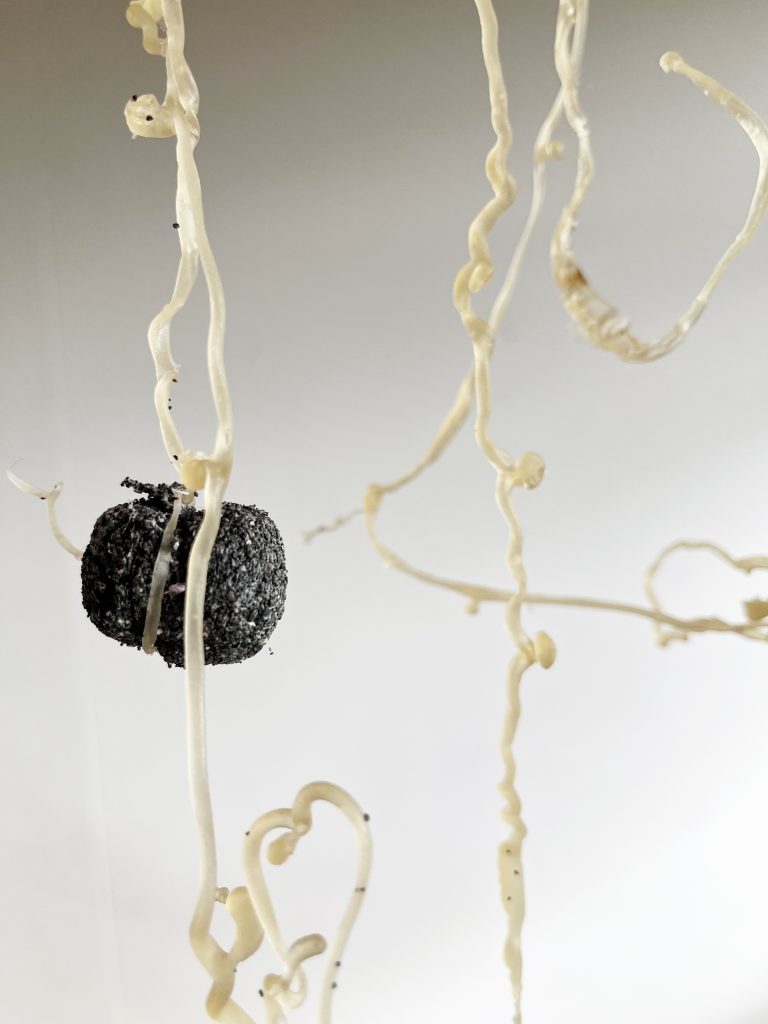
We gathered seaweeds and algae: greens, reds and browns. Sea lettuce, kelp, dulse, rockweed (and more!) were all over the beach. I was drawn to fluffy feather-like red algae and a pale pink petal-like algae. When I picked them up, a tangle of small rocks would accompany the drying algae, suctioned onto the strands creating mobile-like structures.
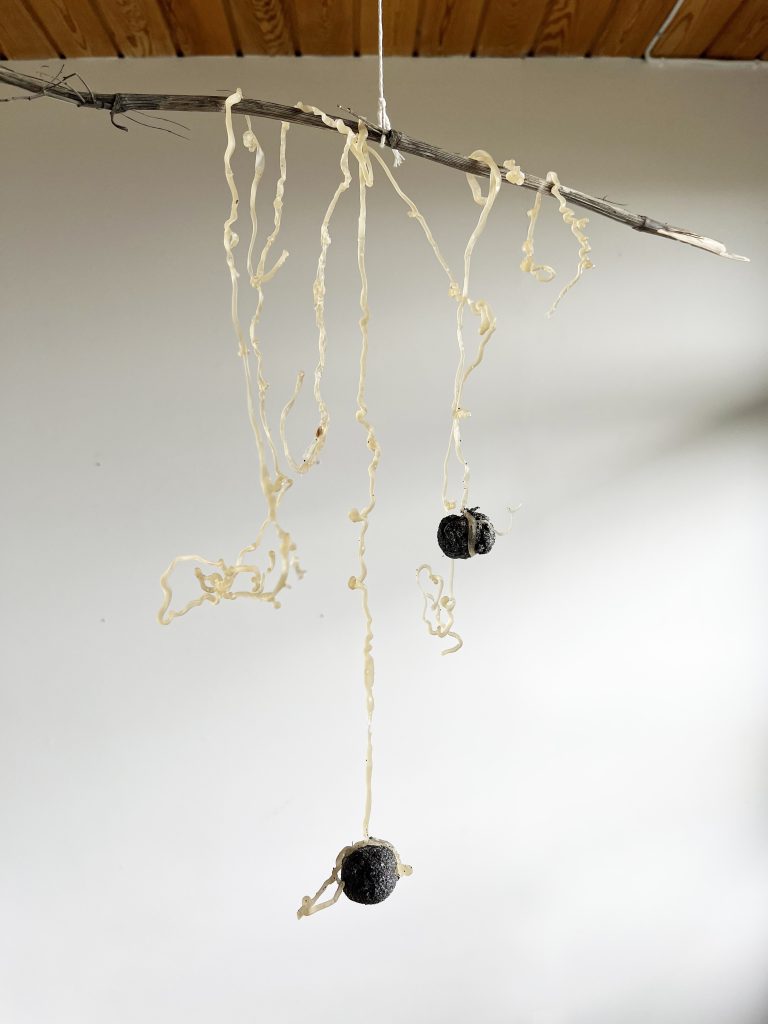
Back in the lab, I took inspiration from mother nature’s mobile to create an interpretation of the dangling forms. Long wobbly strands of bioyarn were spun extruded using primarily of sodium alginate, a thickener made from brown seaweed. Lumps of bioceramic (sodium alginate and black sand) were formed to make the rocks. I wrapped the jelly-like strands of bioyarn around the rocks and let them dry.
Two days later.
The bioyarn dried, shrank and took hold around the rocks-success! The yarn’s wobbly, lumpy forms made it more algae-like. They were surprisingly robust as I laid the forms into a mobile (sometimes falling off and tipping over), but then they found balance and maintain their equilibrium for hours on end (unless I bump into them of course).
More than being in Iceland, I feel we are at the Kvennaskolin beside the river’s mouth, we walk the same halls that women have for a hundred years, and my time has been absorbed by cooking, going to the pool, taking walks, and touching wool. It feels small, really, under this broad expanse of sky. We sit under this red-roofed building and find the staple length of wool, pulling Tog from Þel, finding the difference in centimetres. And within these centimetres exists a world I will probably never know. The farmers and their stories, the story of the sheep whose wool I am touching. The story of a barn door that is loose on its hinges. And I can’t lie and say I don’t ache to know them. I sit here so close to this material, and yet I don’t know the stories of what has brought her to exist. We are meeting each other as strangers, and I worry that I am doing something to offend her. It’s a delicate conversation, the use of material. We have been talking about it a lot, to come to a new place, and use materials whose stories you don’t know. I have been finding myself feeling cautious about using rocks or seaweed, but then again, where does it end? I have been using the wind, and I don’t know her story either. And do I feel like I can work with wool because I bought her? Another person gave this to me for use, but I have yet to learn her story. To begin to know a material is a delicate dance. I suppose we will hurt the feelings of those we love; there is an inevitability there. I hope I can hear her when she tells me so.
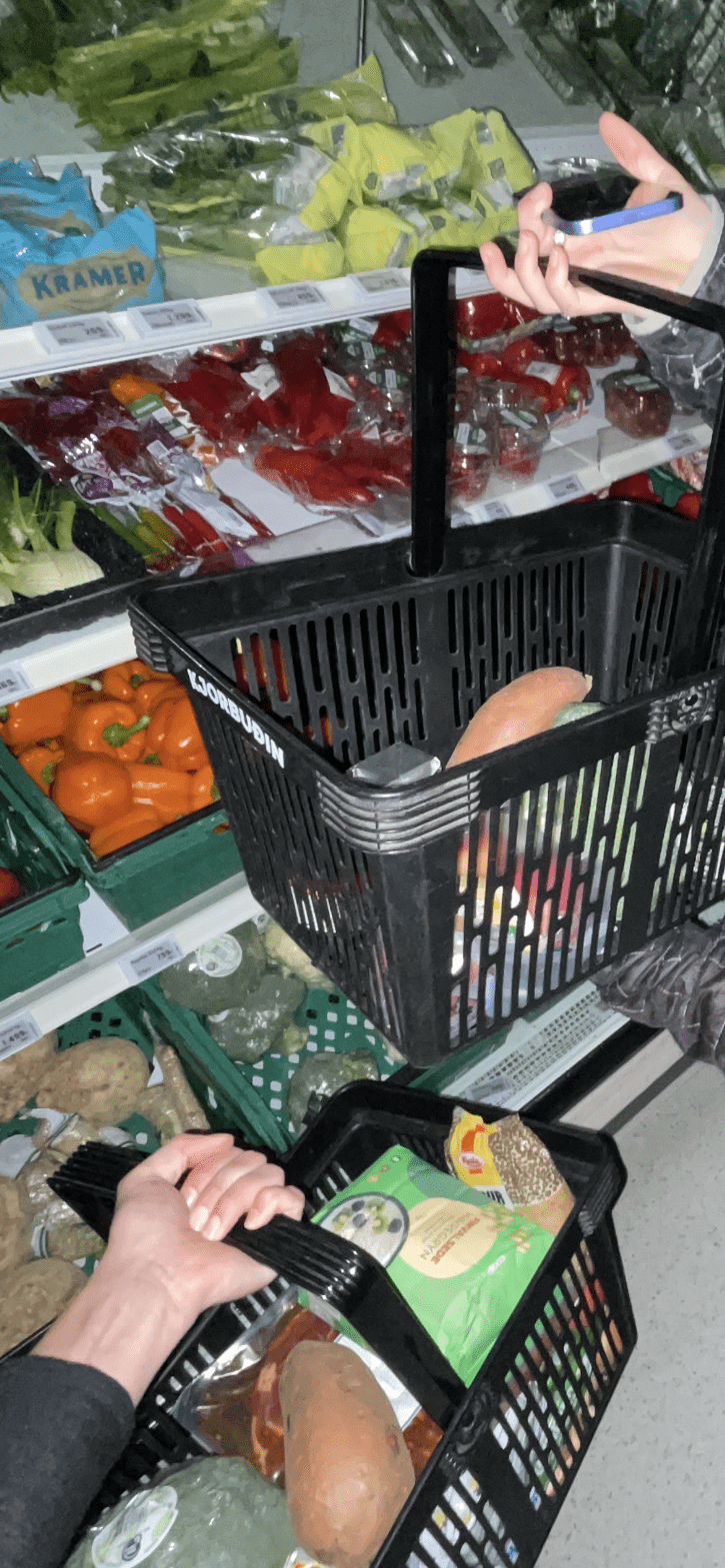
Grocery Shopping in the dark
Perhaps it’s like a trip to the store. You go with your list
On your list, you have a number of items
Items you intend to buy
You enter the store and begin your shopping
But all of a sudden, the place goes dark
And you can’t be too sure what you need anymore
It’s all dark
And the things that seemed attainable, a list items to be checked off is gone
Your surroundings have changed, and there is a rather large obstacle,
because of course you can’t see in the dark, and you left your night vision goggles at home because it’s always light here
But then you wander around in the dark, bumping into things, feeling around for potatoes and pears. And now you need to feel a little more, inspect their edges, the tips and stems, skins and lenticels.
It might be harder, but perhaps it’s more interesting anyhow
And perhaps you will leave with a surprise!
Two Step
Dancing in the wind
Entangled in one another
I am trying to match the rhythm she is finding in the wind
As we spin, I wonder if synchronicity is really the same as harmony
I think perhaps not
I wonder where I got that
Edges
A woman who turns into the landscape around her
Shifting into rock
Or something less solid
Wind?
I’m trying to figure out where I end and begin in this new place. Understandings that seem to be floating just above me in the endless light.
Sometimes, often actually, I think I would like to be a young windy love, one that dissolves itself in others, giving itself over fully to the cause, to lose my edges and feel that they will be absorbed fully and gladly.
The expanse here leaves no limit to where my edges might go, and I can feel fear, trying to pin them down to keep them in my sights.
I brought 3 books to Iceland: All About Love by bell hooks, The Subversive Stitch by Rozsika Parker, and Last Night at the Telegraph Club by Malinda Lo. Two smart books and a fun book, I thought, planning to give myself extra credit for reading all 3 while I was here, despite having started both smart books long before leaving Montreal. Since arriving, I’ve only cracked the cover of the fun book.
I talked to an Icelandic woman who works as a kindergarten teacher. When we complained about the expensive grocery prices we’ve encountered, she told us to try dumpster diving. She explained her strategy that she uses at home in Reykjavik. Then she taught me how to knit.
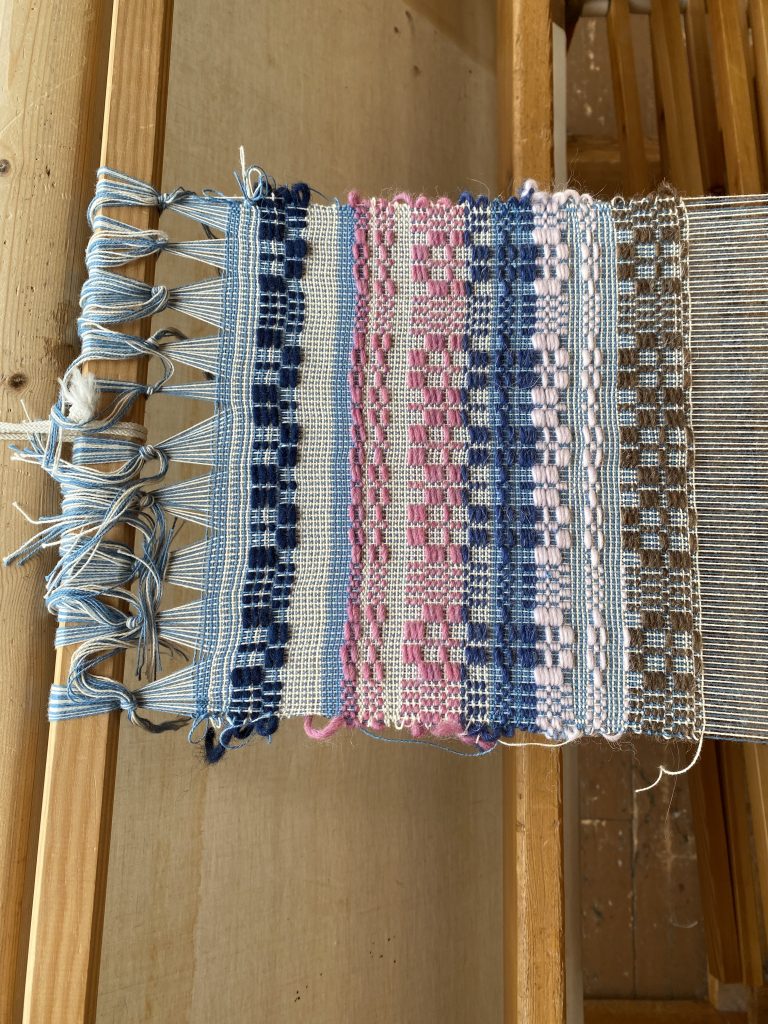
Zoé and I spent the last week dressing one of the countermarch looms in the weaving studio. I have the first turn weaving on it. I’ve been wondering about the women who worked on these looms before me. Ragga told us that the looms were built on the Textile Center grounds in 1924. Many of the looms have names of past students crudely carved into them. I feel the previous weavers watching over me as I pass the shuttle back and forth between sheds. I hope that they’re not judging my selvedges.
It’s been extremely windy here for what feels like a full week. To get some respite from it, we’ve started taking the river path to the pool instead of the sidewalk. My boots got dirty and Andre showed me how to clean them with his horsehair brush.
I woke up today to a scratchy throat and stuffy nose, having finally caught the House 35 cold. I filed that away in my pile of evidence that this is in fact the real world, accompanied by: I still interrupt people when they’re talking, I always seem to be running late, I look for hummus at the grocery store. Counter evidence includes: my hair always looks good despite getting wet at the pool every day, I’ve yet to get a substantial sunburn, and that it never gets dark outside.
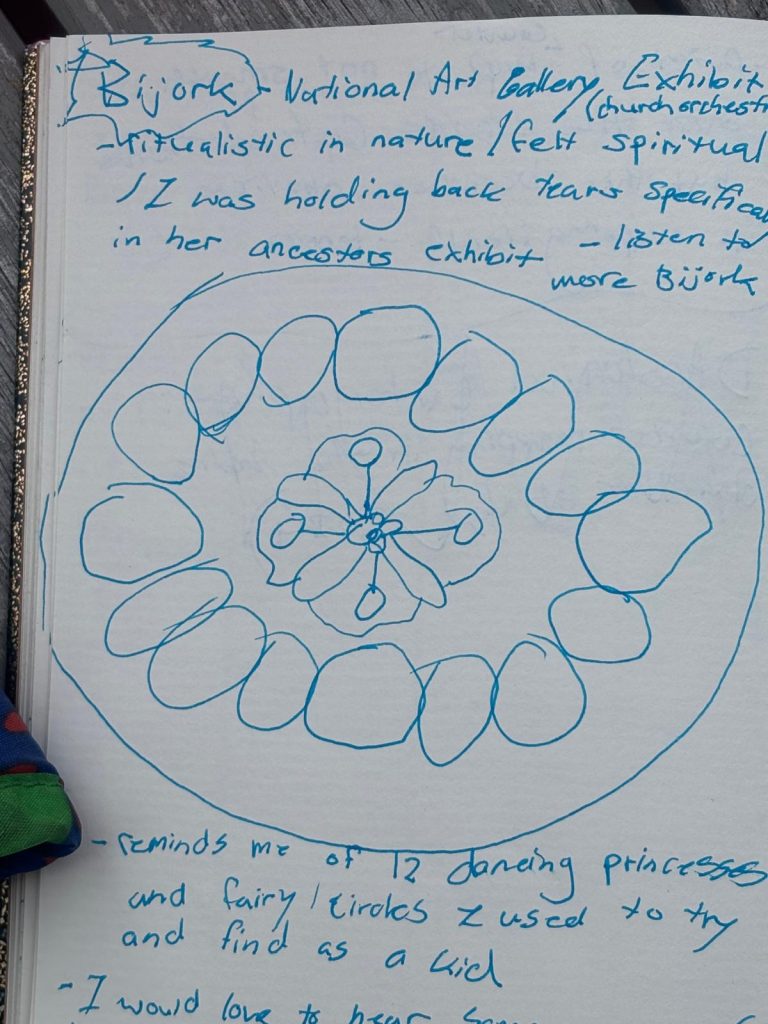
I am not particularly a spiritual person, but I keep having dreams where I am weaving in a ritualistic fashion, and I have been noticing a lot of circles of rocks on the ground, which remind me of when I was a kid and obsessed with trying to find fairy circles or fairy rings in the forest. I have decided these are enough signs to write my post about rituals, rocks and circles.
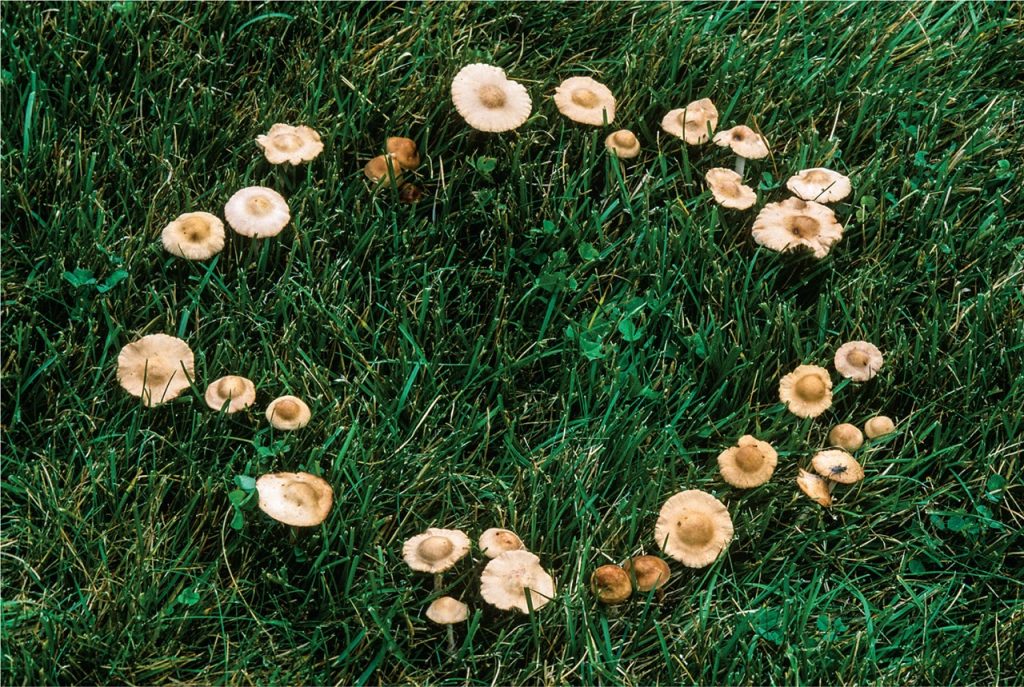
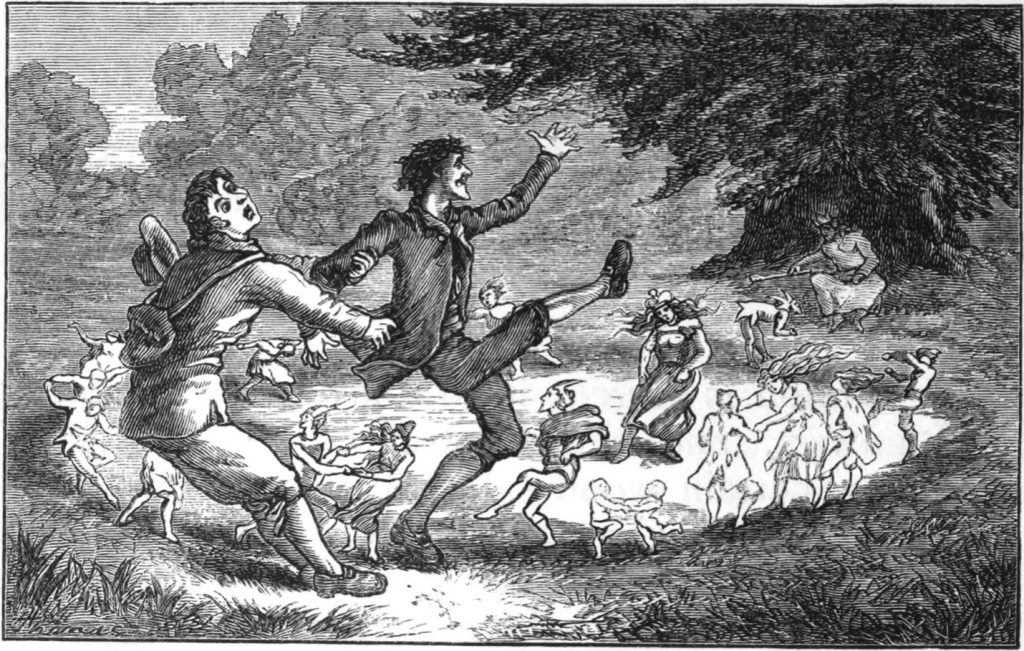
For anyone who doesn’t know what a fairy circle is, it’s a naturally occurring group of mushrooms that are growing in a circle. The mycelium beneath the ground consumes nutrients at the center of the circle and gradually spreads outward. As you may be able to guess, fairy circles have a lot of folklore and mythology surrounding them, especially in English, Scandinavian, and Irish folklore. They believe that fairy circles were formed by fairies or elves dancing in a circle, usually at midnight or dusk. Entering a fairy circle is generally frowned upon because it is thought to bring bad luck and is dangerous, as they act as doorways to other realms.
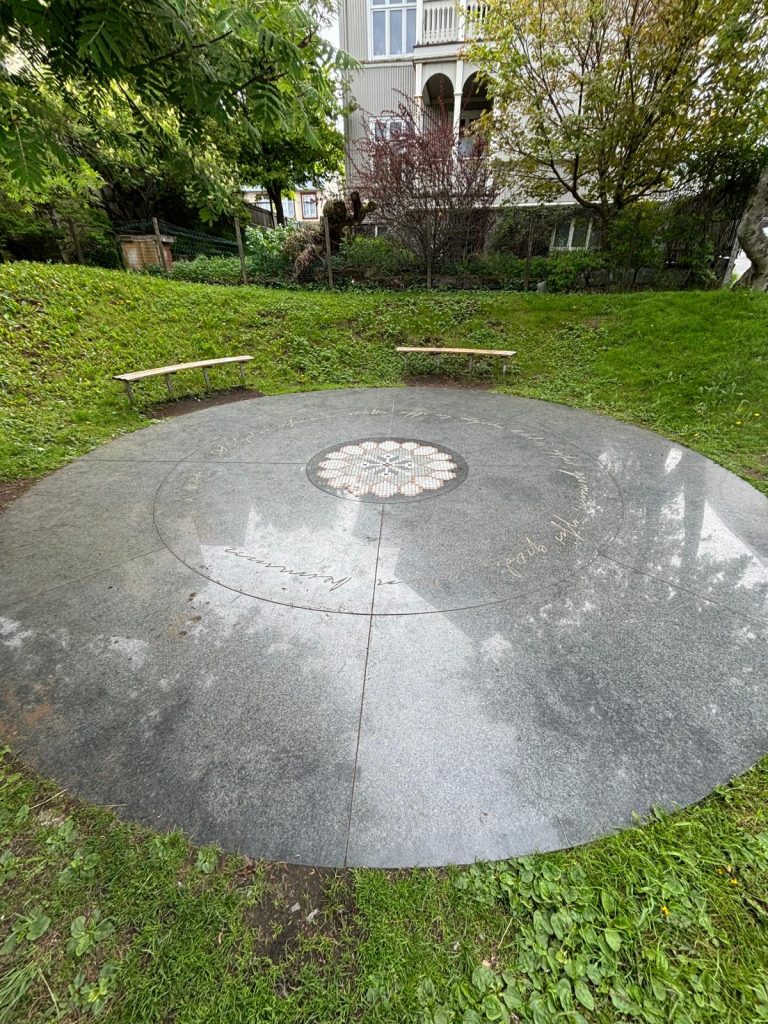
What first got me thinking about fairy circles was Björk’s exhibition in Reykjavik, specifically the one called Ancestress, which “reckons with the cyclical nature of life. Set in a remote valley in Iceland, the lamentation is staged as a ritualistic procession of musicians and dancers” (from exhibit description linked below). This exhibit focuses on the grieving process of Björk losing her mother, and had me transfixed. I literally sat in this exhibit for like 2 hours. I definitely recommend going if you have time before you leave. After I left the exhibit, I found a park with what I would describe as the Barbie Twelve Dancing Princesses doorway circle, but maybe that’s too niche a reference, so here are photos and a video for context.
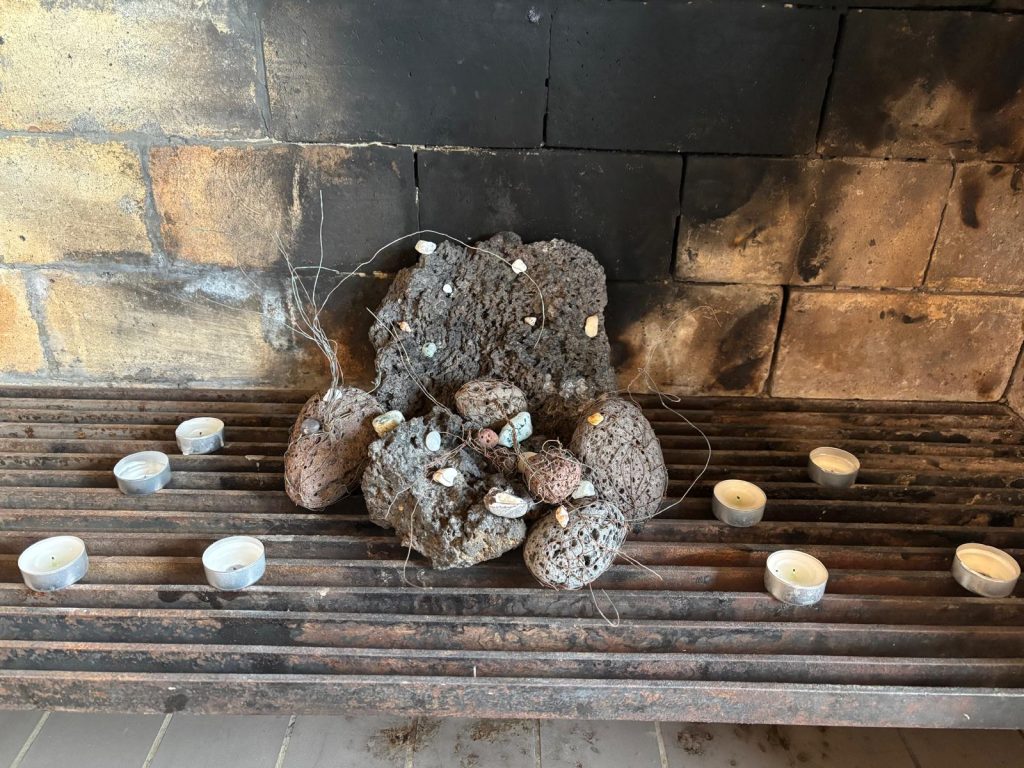
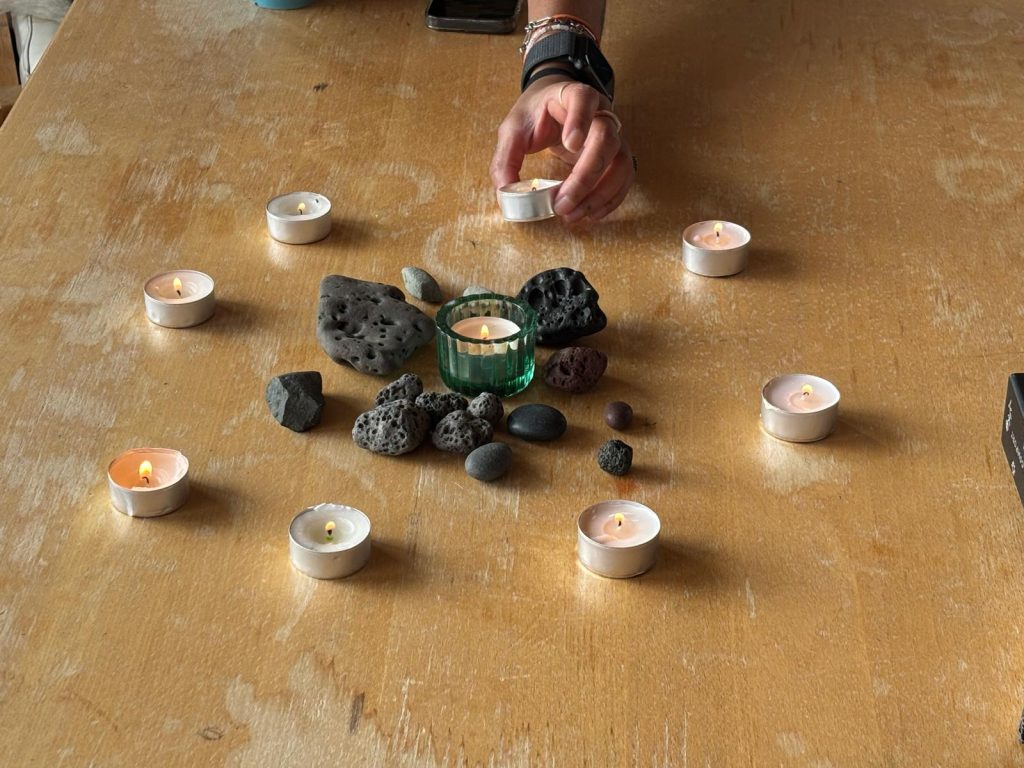
When I arrived at house 35 on our first day in Blönduós, I immediately noticed this altar-like rock structure in our fireplace (picture below). What a perfect place for an altar, and what a perfect misty day to notice it, with fog as the only thing I could see out of the windows. Had some travellers done a ritual here? What was the ritual for? Had the hidden people accepted their offerings? Are there even any houses other than the Textile Centre in Blönduós? A few days later, when it had become less foggy, house 35 decided to do a ritual of our own. As excited travellers, we had already picked up rocks and shells and brought them into the house without asking. We apologized altogether, and each said a few words of thanks for letting us enjoy this amazing place, people and environment.
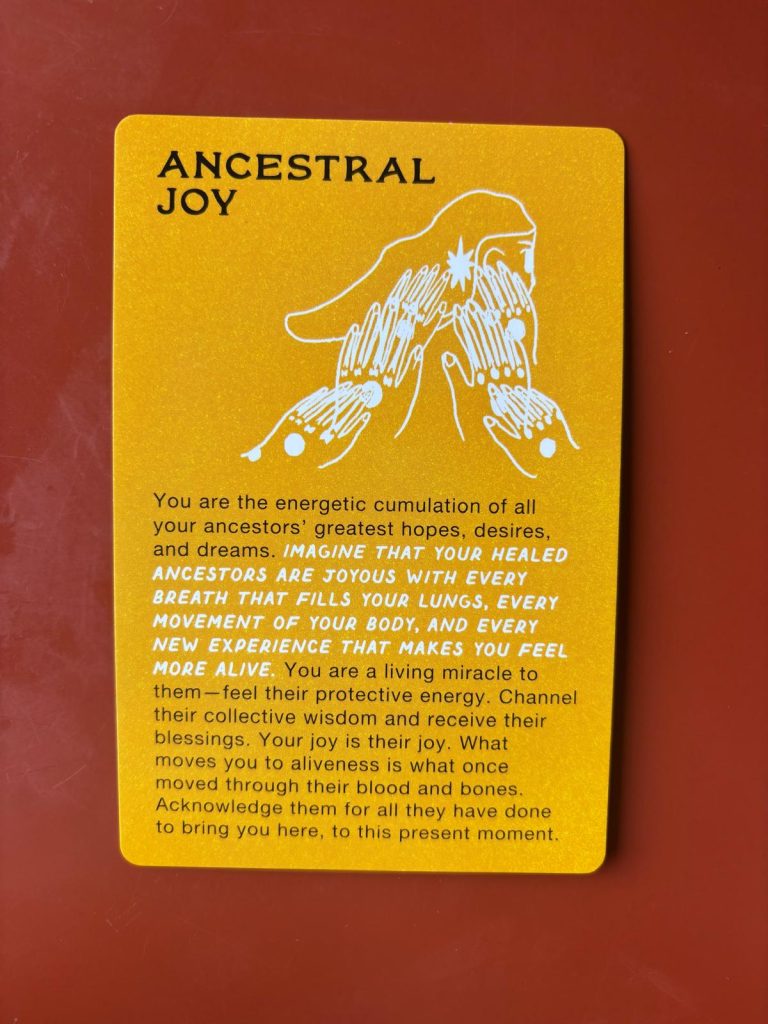
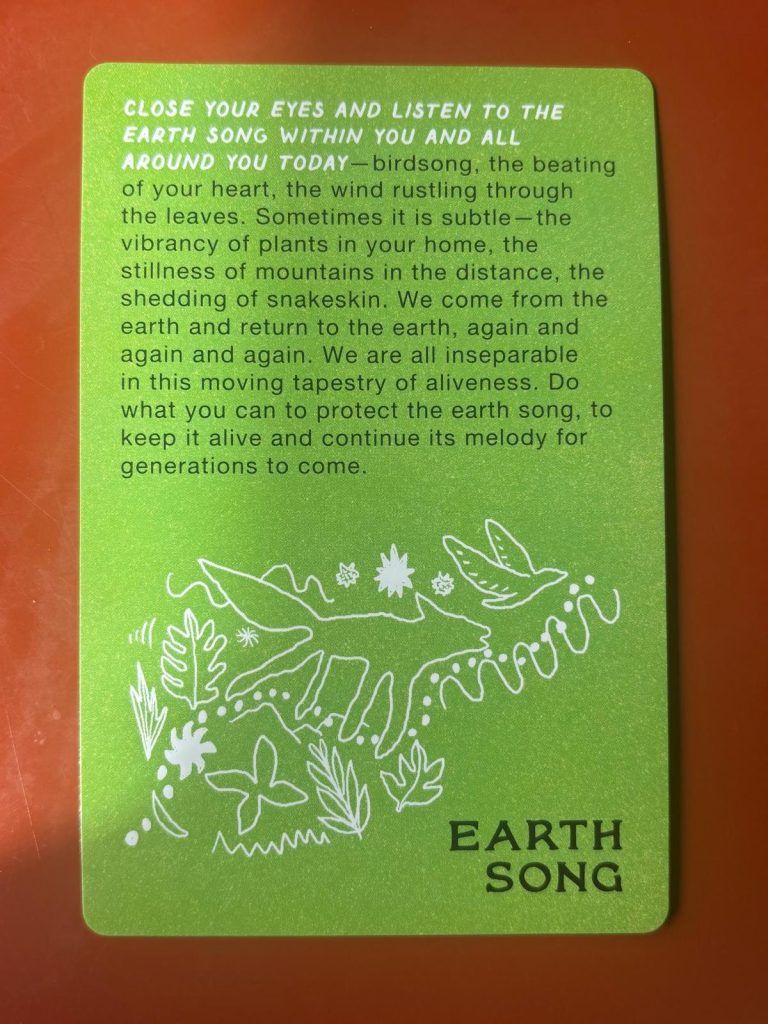
After our ritual, I sat and thought about the connection between fairy circles, as in-between places where you can reach other realms, and the Icelandic hidden people, huldufólk, who don’t appear in sacred spaces necessarily but appear at in-between times, and in-between places. Johanna later confirmed this during her spinning lesson as she discussed the huldufólk and the solstice’s continuous cyclical light. She explained that the Solstice is a time when lots of doorways open. I don’t necessarily believe in rituals or superstitions, but I have had a lot of fun picking Shannon’s oracle cards every morning with house 35. Here are some of my favourites picked up right before spinning (Ancestral Joy) and right before weaving (Earth Song).
Somehow, under the midnight sun and flowing through the heavy wind, all the days have woven into one. We blinked and are now just past the halfway mark of our time in Blönduós. If I tried to capture my experience at the Textile Center so far, and in one word, it would be “grateful.”
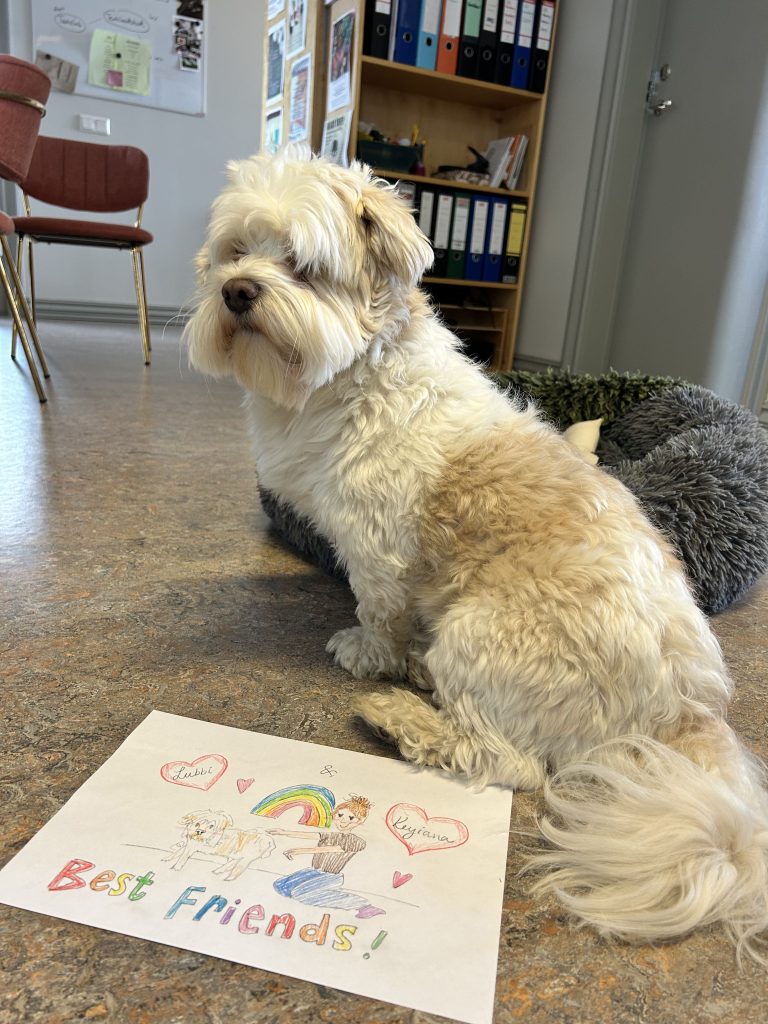
Elsa and Lubbi have made the center feel like home by welcoming us with open arms (and paws).
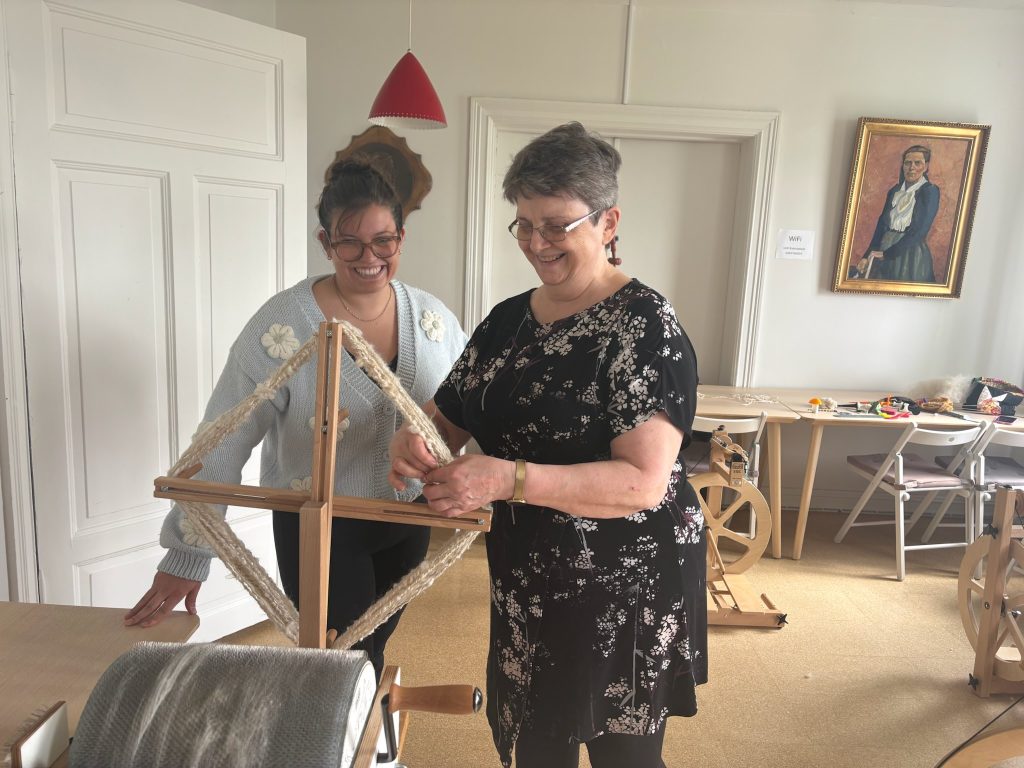
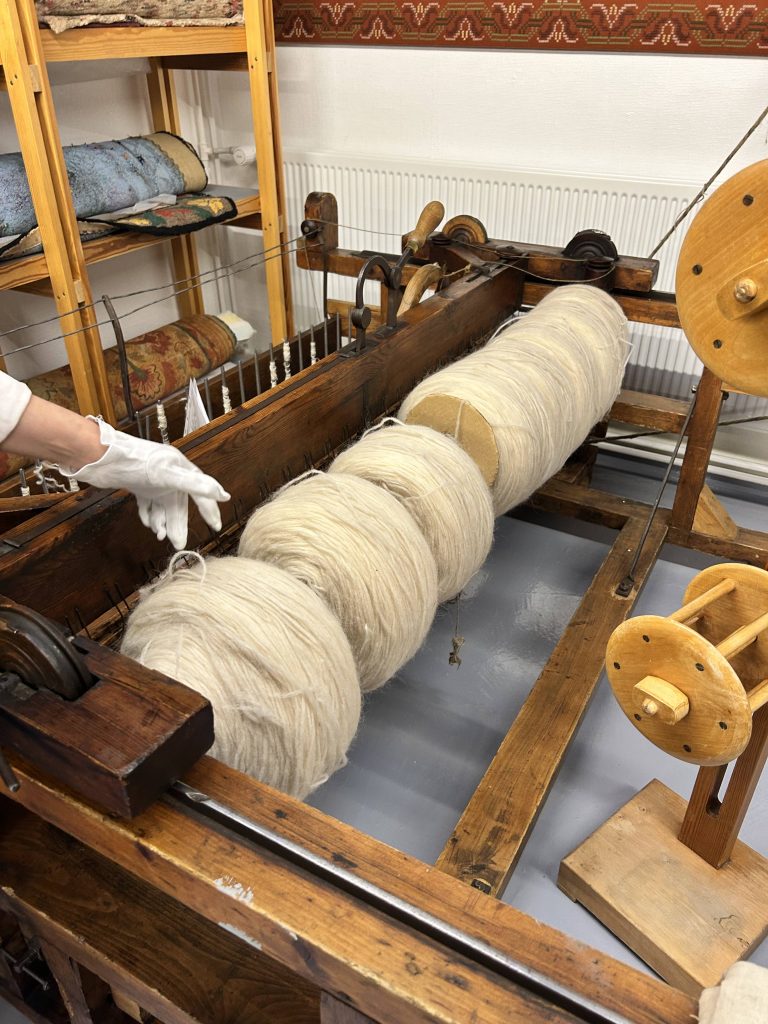
Bearing precious wool from her sheep, Jóhanna made us learn “the hard way” to better hone our spinning skills. She shared her life’s work, detailing her tips and tricks to help us learn.
Ragga simplified the country’s extensive weaving history to inspire us, and made weaving seem like child’s play. When we struggled, she reassured us that she had “seen much worse”.
After foraging with us, Þorgerður shared her invaluable natural dye recipes. She allowed us to learn in a hands-on manner, truly believing in us every step of the way.
Sarah and Alyssa have let us run around the lab, playing like we did as children. They are the center’s fairy godmothers, helping our wildest art dreams come true.
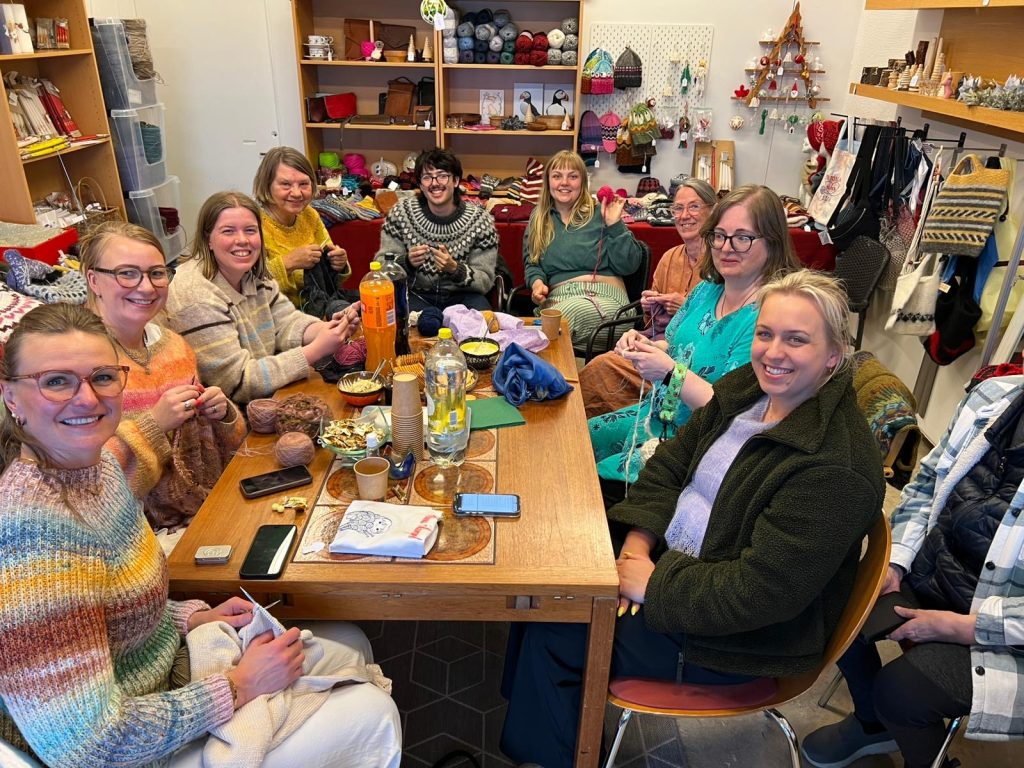
In the past 17 days, we have also had the chance to some-what integrate the community. During the knitting festival, two women from Reykjavik taught us to knit on a picnic table outside the community pool. One proclaimed that a good knitting session always started by someone telling their life story, and with that, shared stories of her upbringing, her children, and worldly travels. The other woman, Vika, took turns around the table, carefully placing yarn around our fingers.
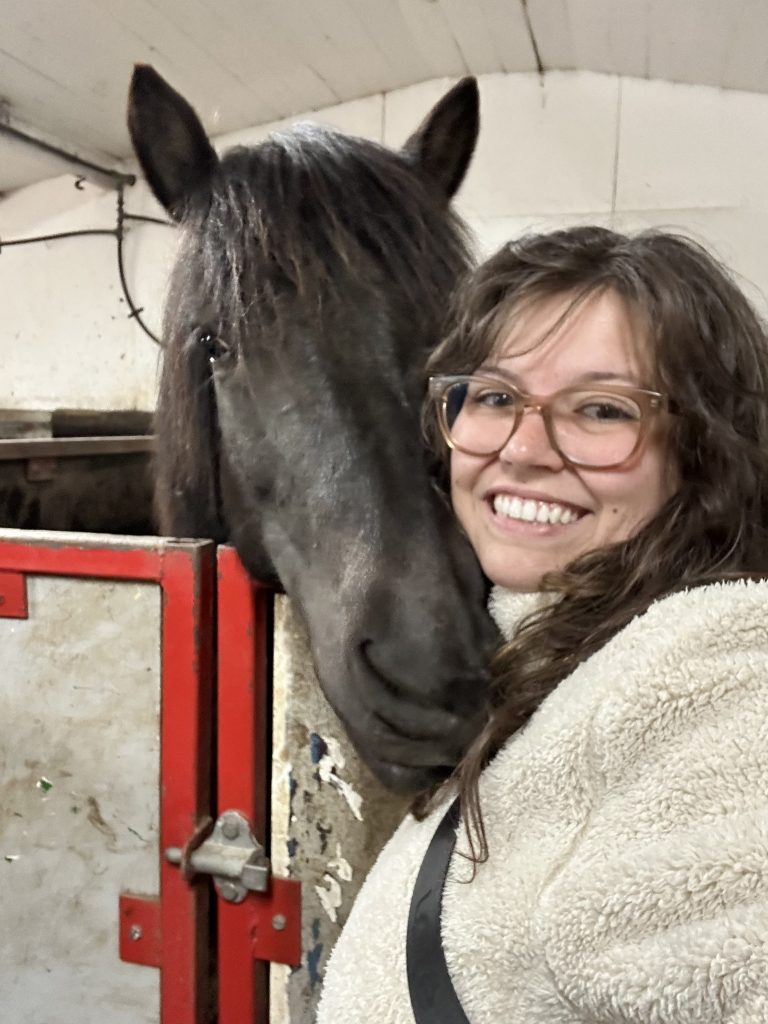
Jóna, a local farmer, invited us to visit her horses. She detailed their history and training as our fingers got dry with dirt, scratching their necks. Squished in the staple, we all had big smiles on our faces as we made genuine friends with the animals and their keeper.
We met, Elin, the Textile Museum director, who generously gave us a tour of the space. She let us explore to our hearts’ desires, allowed us to flip through sample books, and told us to come back any time.
How could I not feel “grateful”, or privileged, or inspired? I will leave Blönduós with countless new skills and riveting stories, and thanks to these women, so much more. Thank you to everyone who has had a hand in making our experience at the Textile Center an unforgettable one, including Kathleen, whom of course, was the master weaver in this case.
Living with artists. Shannon pointed out how rare it is to live with people who get as excited about art making as you do, and it is very true. There is constant affirmation and we are all on this wavelength of creation. How lovely it is to wake up and immediately find artists in their element. How could one not feel inspired?
Sunny days. For some reason I had resigned myself to expect a lot of cloudy weather, and while we have had some foggy days, there has been sun. Lots of sun! An immediate mood-booster.
The roaming cats. So many friends to be made, not enough time.
Californiu Dark Chocolate Raisins. In the literal sense, I have been living off of these. I suspect I will be 50% Dark Chocolate Raisin by the end of the month.
The pool, obviously. Specifically, the part of our curcuit that takes us from the hot pot into the pool is maybe my favourite experience ever. It is what I imagine heaven feels like. Pool culture here is unlike anything I’ve experienced.
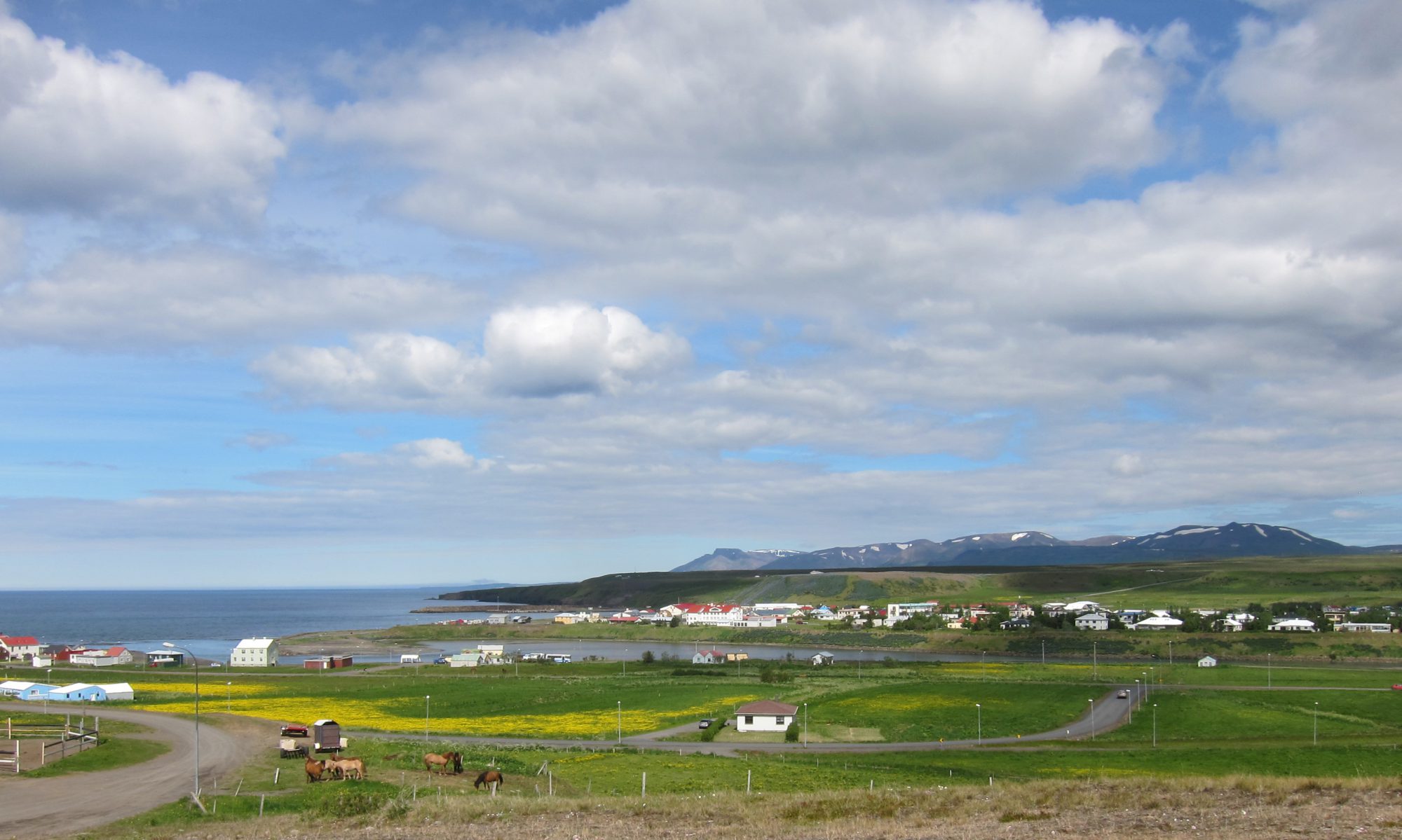
The landscape. This is pretty broad, but I don’t think I could ever get sick of looking out my window. There is always a new way the light hits the water or the tide reveals a patch of sand. I get just as excited as the birds do!
My bedspread. It took me a week or so to realize that I am the only person with a massive galloping horse on my bedspread while everyone else has flowers and pink checked patterns. It has given me a lot of joy to sleep under that horse. I feel very protected.
Gilles Deleuze describes the “crystal image” (Deleuze, 1985/1989) as moments in which past, present, and future refract through one another, each facet catching light from the others. Writing about “place” from Blönduós, in the present, my thoughts are nested in that shifting structure: memories, speculative imaginings of a family history of immigration from Västergötland, Sweden, to North America just before 1900. I am experiencing my time here — this absolute luxury of time — attempting to notice what I am noticing, watching for the flashings of synthesis that surface and sometimes settle in my awareness.
I visited Iceland for the first time forty-one years ago, in 1985. My first steps off North America were in Reykjavík, with a group of sixty American college students and our leaders, all of us spending our junior year abroad on a program called Scandinavian Seminar (https://scandinavianseminar.org/). We travelled together in Iceland for several days before orientation in Copenhagen, language courses in our respective countries, home stays, and then a school year within the Scandinavian adult education system known as folkhögskolor, or folk schools (https://folkbildningsradet.se/om-oss/translations/english/the-folk-high-schools/). My folkhögskola placement was at Hellidens (https://helliden.se/), in Västergötland. It is a school with a craft and design emphasis, and by chance, not thirty miles from my living Swedish relatives and the family farm.
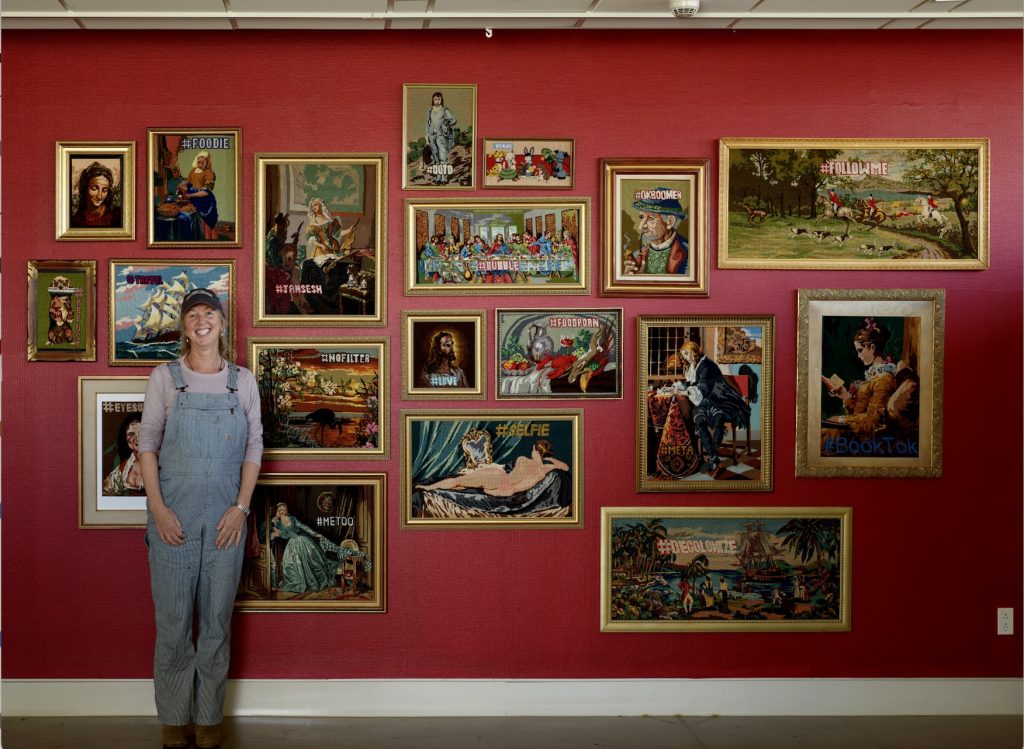
The foundation of Scandinavian Seminar was/is language immersion. This formative experience for me became the touchstone for my curiosity as an artist, exploring the privilege of the English language as world lingua franca and adjacent rabbit holes of research that include a consideration of globalization, mapping and borders—coming more granularly into focus upon my own eventual immigration to Canada from the United States. Signalling the Old World from the New (2023) and #HEGEMONY (2022) are two examples of this thread running through my research.
#HEGEMONY (2022) Beaverbrook Art Gallery Artist in Residence
Living now with my classmates at Kvennaskólinn, approaching midsommar in this uncanny and unlimited daylight, the present time is imbued with facets of memory of that year living in the castle at Hellidens — the Helliden slott — vignettes layered and refracted with what has transpired since those first baby steps, at the age of twenty-one, stepping off a plane from New York to Reykjavík.
Jen Wiebe
References
Deleuze, G. (1989). Cinema 2: The time-image (H. Tomlinson & R. Galeta, Trans.). University of Minnesota Press. (Original work published 1985)
Folkbildningsrådet. (2026, March 10). The folk high schools. https://folkbildningsradet.se/om-oss/translations/english/the-folk-high-schools/
Hellidens folkhögskola. (n.d.). Hem. Retrieved June 19, 2026, from https://helliden.se/
Scandinavian Seminar. (n.d.). Home. Retrieved June 19, 2026, from https://scandinavianseminar.org/