As a teacher and artist coming from an installation, painting and drawing practice, the thought of learning about new techniques and acquiring new skills is always exciting. With this mindset, these fresh experiences are usually enlightening and satisfying. Usually. Spinning wool proved otherwise at first.
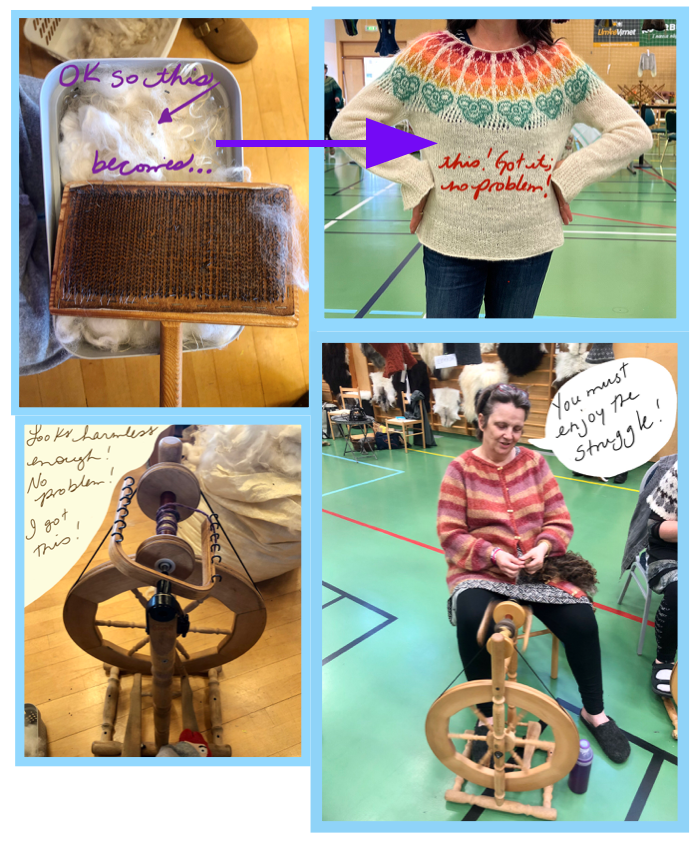
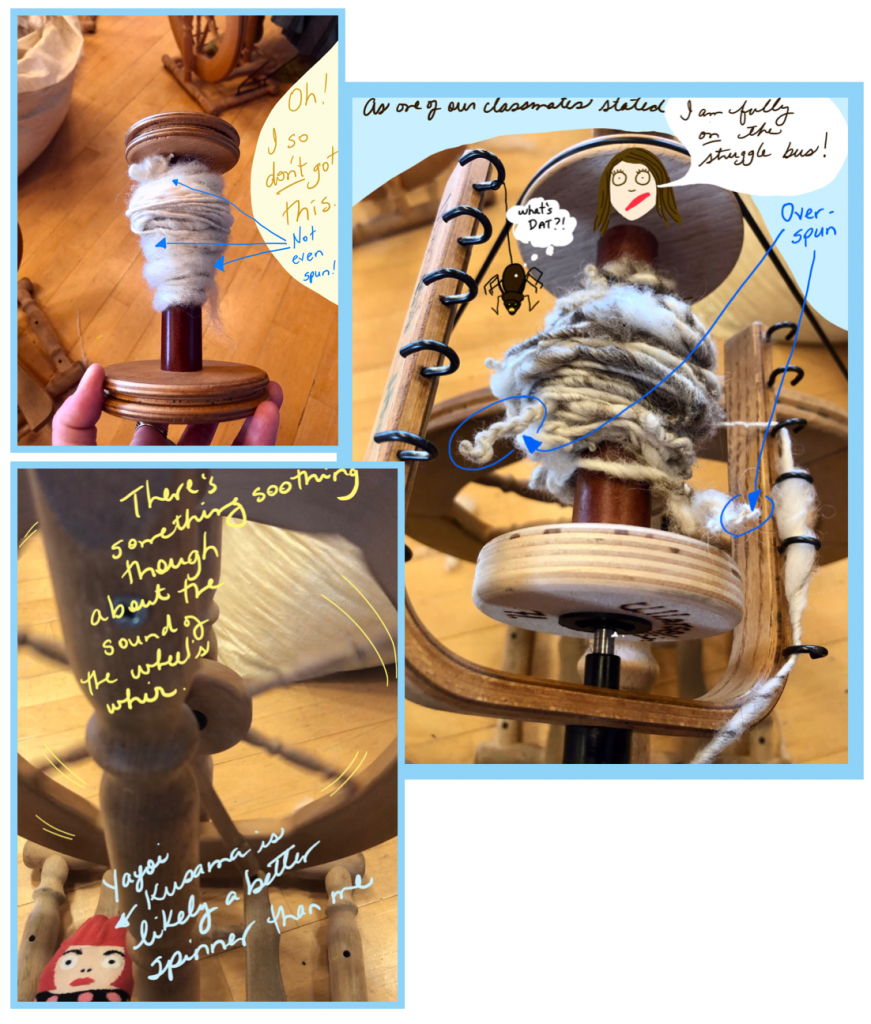
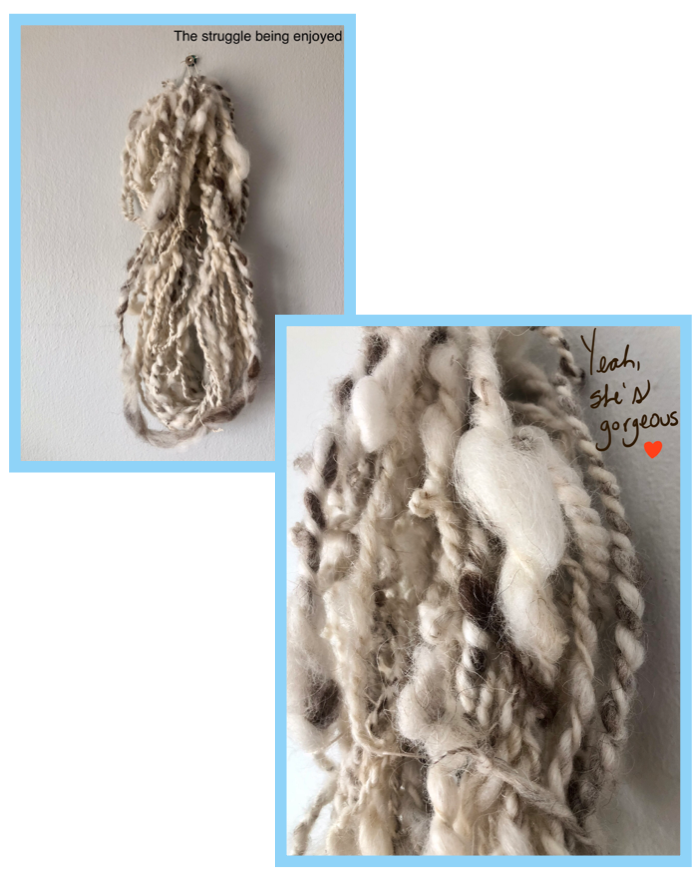
Johánna, our very very experienced spinning instructor (not the stationary bike kind) was gracious, informative and physical in her demonstration. As she covered my hands with hers to help me mimic the gentle push and pull motion to feed the spinning wheel, I was confident I would “get it”, even though she repeated many times that our priority was to enjoy the struggle. I was SO not getting it. Mistakes were being made all over the place. I had no idea what I was doing, no matter how many times Johánna showed me. I was getting so frustrated that my fleece strands were not being spun evenly on the bobbin that I found it impossible to enjoy the struggle. I was more in the same frame of mind as some of my classmates who wanted to “get off the struggle bus”. My fleece was not turning into the beautiful, even, delicate and romanticized wool strands from the cute sheep I had seen earlier in the week, but rather became a gnarled, over-spun, thin, yet bulbous hot mess. But I still had fleece left, and my strand had yet to be plied (look at me using wool lingo!), so I was not done.
Besides learning about a new technique, what became relevant to me as the session wore on was how Johánna’s words connected to my current research on mitigating fears of making mistakes in the high school art room, so promoting the enjoy the struggle mantra was apropos. Putting myself in the frame of mind of my students who are expected to try new techniques with this same “it’s ok to make mistakes” growth mindset, I shifted my perspective.
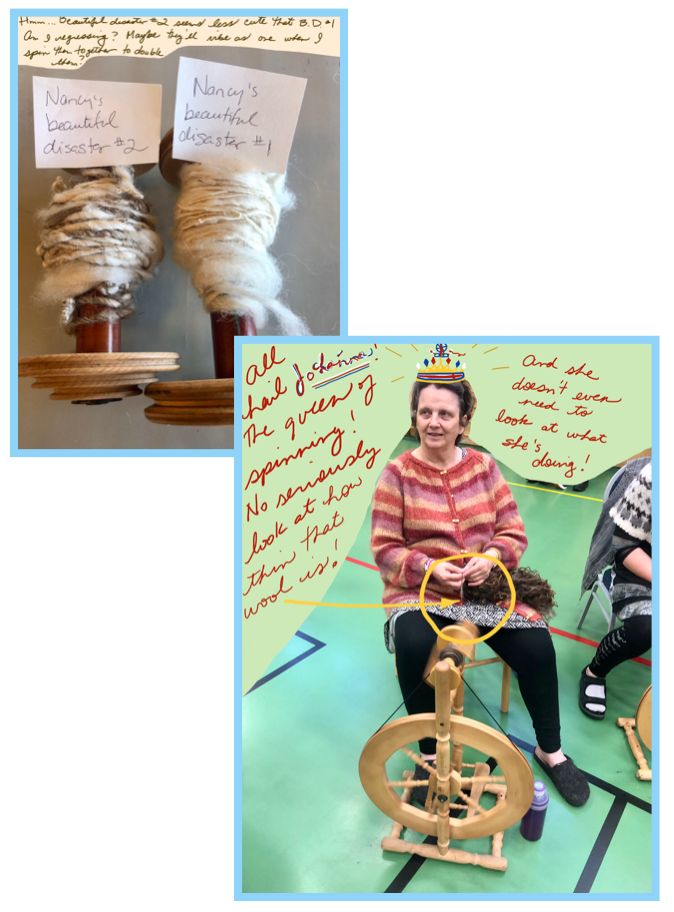
I sometimes must remind myself that I am here not as a teacher feeding my professional development, but that I am here as a student; so, I am learning to spin. I took a few more stabs at it and plied my single strands together with not much more ease than with how I started. Yes, it’s a total disaster, but that’s ok. It’s gnarled and over-spun, thin, yet bulbous, and soft and light and two colours. It’s a beautiful disaster.
That gorgeous wool sweater I bought during my last travels? I think I need to perform a small gratitude ceremony to spinners past, present and future every time I put in on now. During my spinning time, I looked over at a classmate, who is clearly practised at this. I studied with awe their very carefully timed, deliberate yet unhurried hand and gentle arm movements. It’s not that I was unaware of wool’s passage through spinning on its journey from sheep to clothing. What occurs to me now is that I never factored the spinner’s physicality – their body rhythms – as connected to my garments, and subsequently to me, when I put on my wool sweater. It is sometimes the case, as has been proven during my talks with some of the vendors at the Blönduós knitting festival, that the spinner is also the knitter, but in most instances, the knitter gets all the glory. Here’s to those who “get it”, who can beautifully channel their inner-arachnid, and who need a little spotlight of their own.
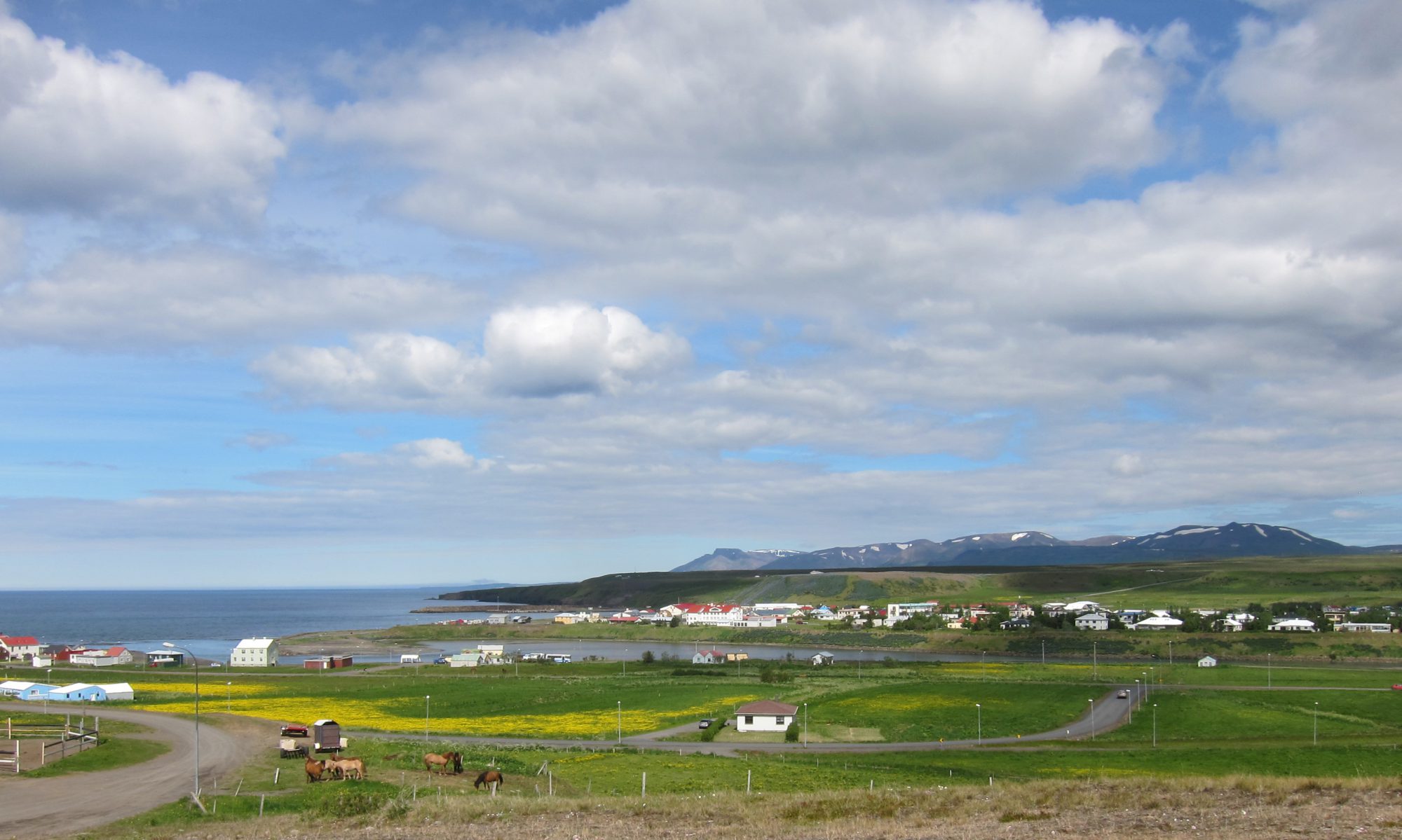
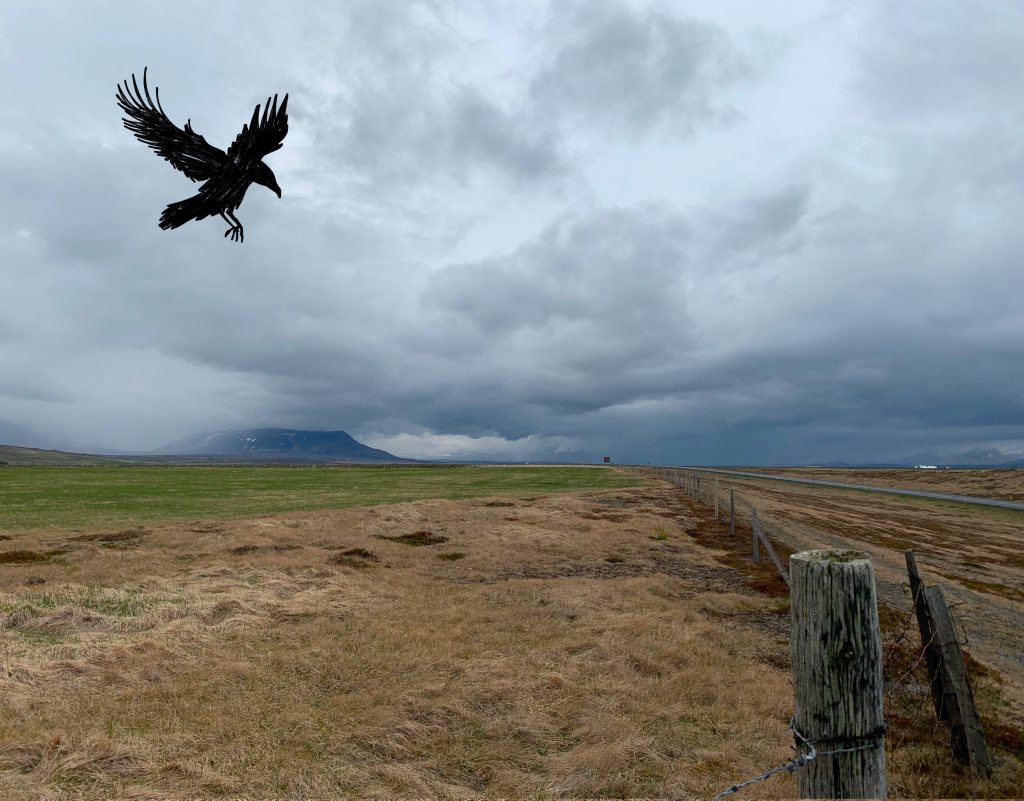
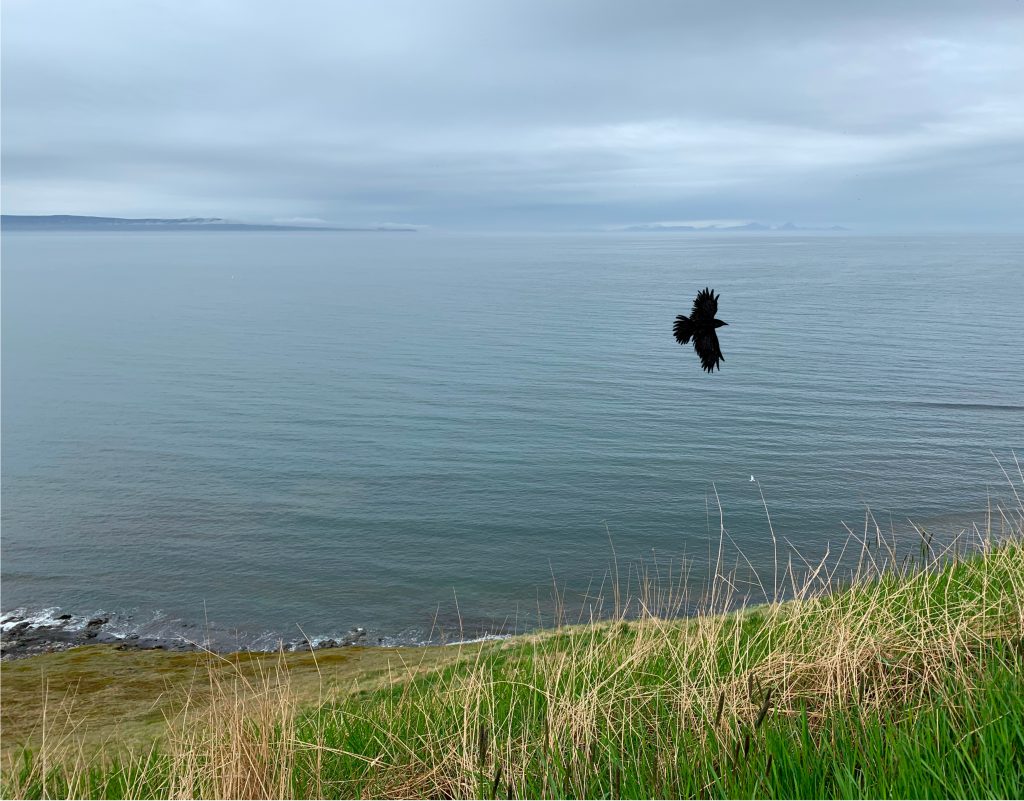
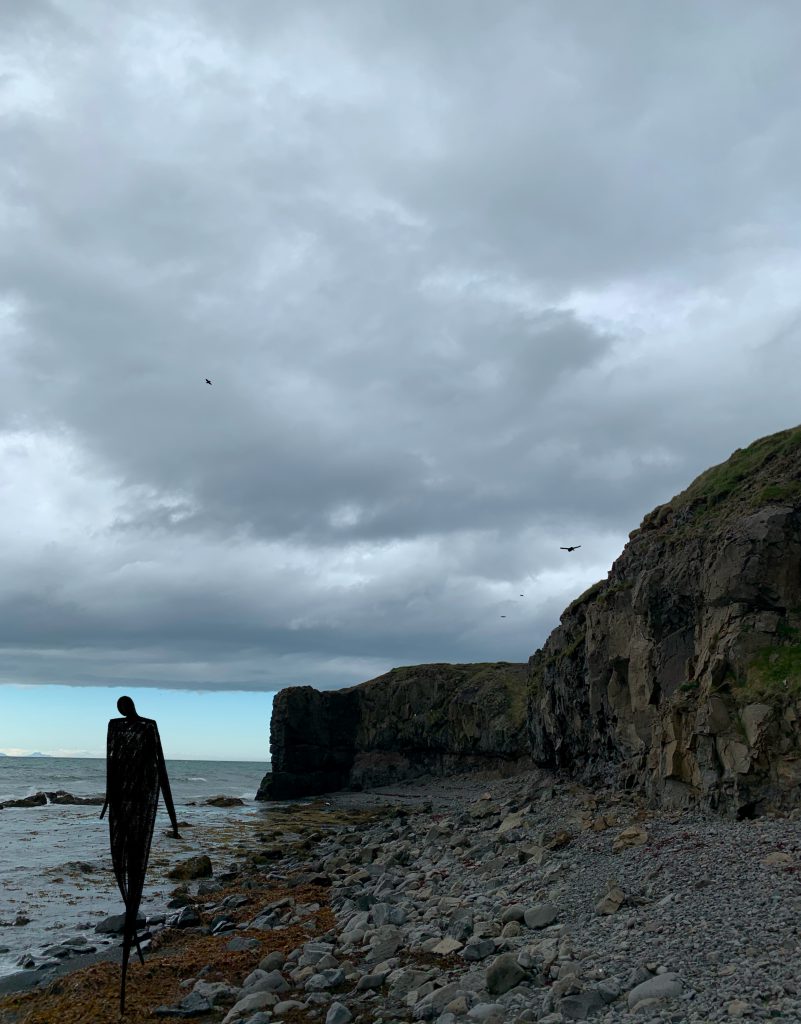
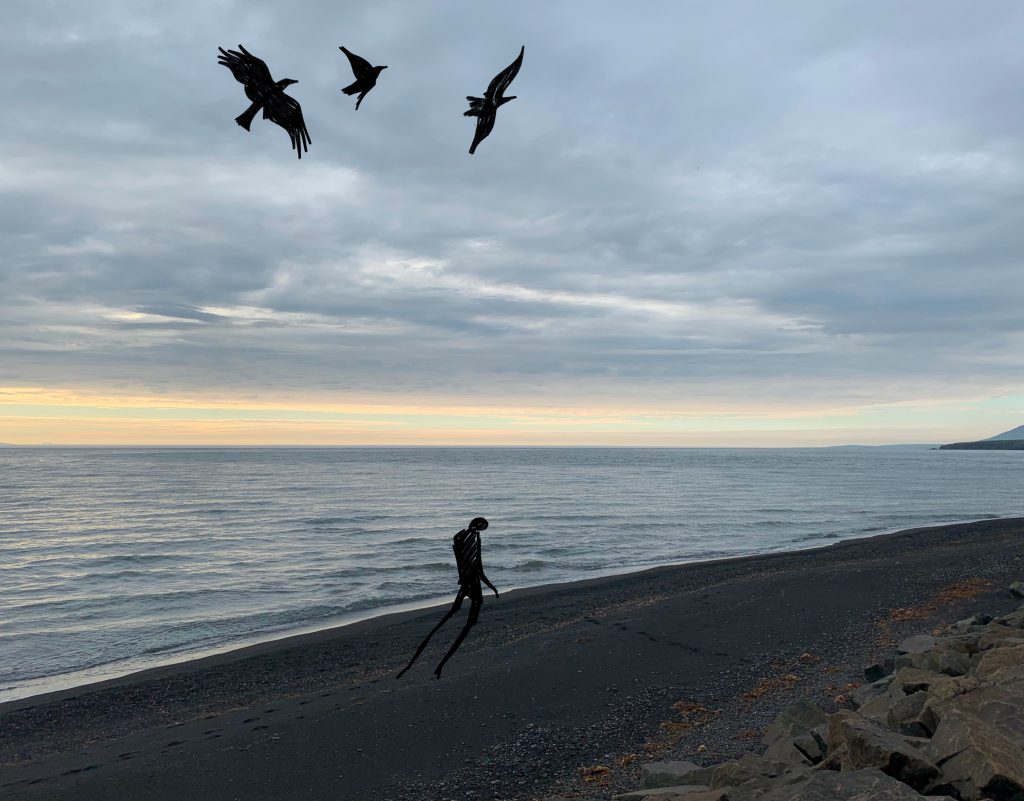
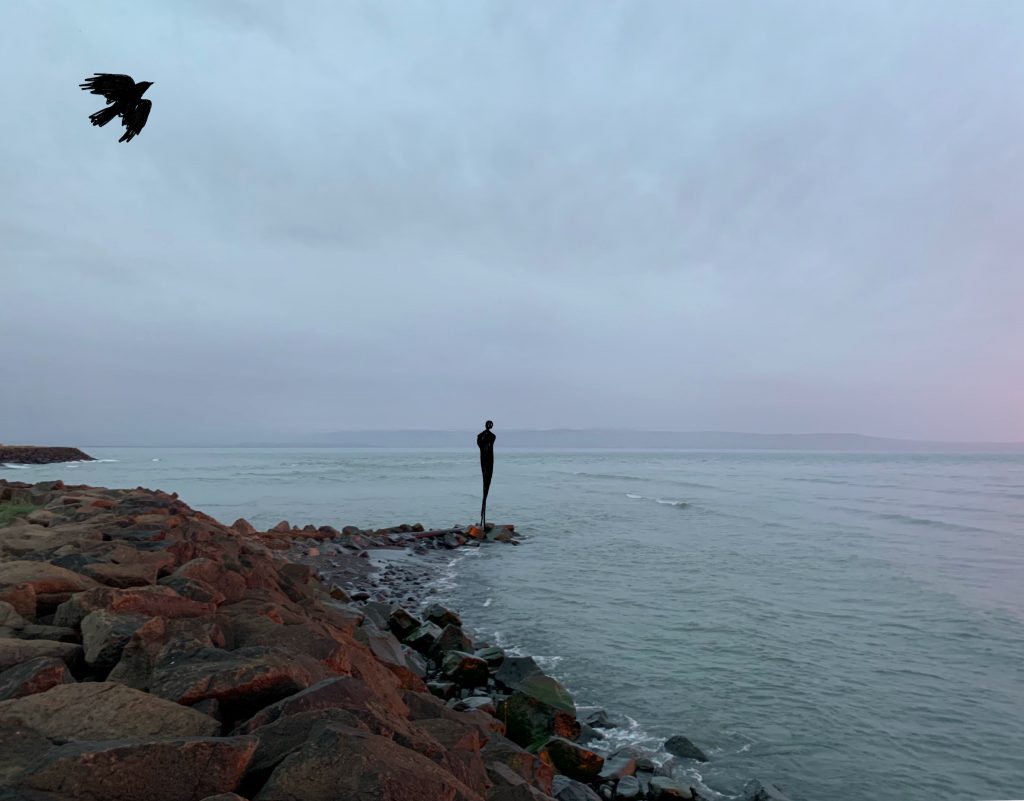
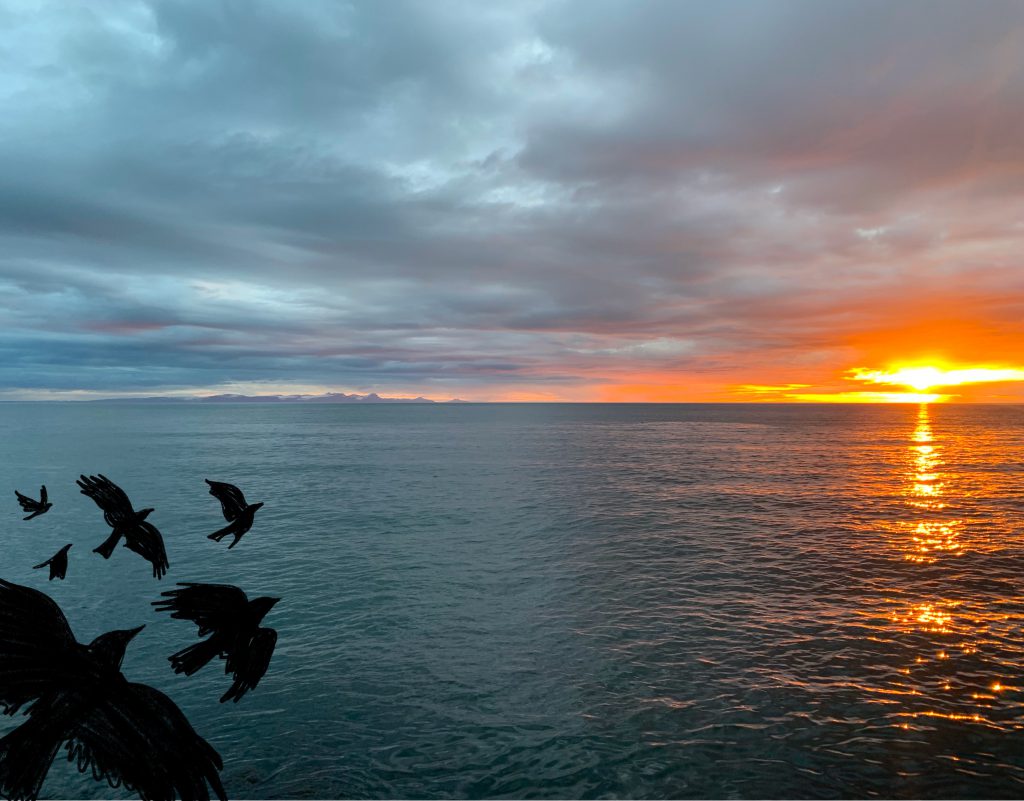
Since arriving here in Blönduós, now 17 days ago, I have really been trying to prioritize my time outdoors. Living in cities my whole life, I have always appreciated any stay in a rural area that much more. It is so easy to take for granted the need to slow down our pace of life; to consider our surroundings and appreciate the beauty of the natural landscape. The Icelandic landscape holds its own unique and special kind of beauty, which both confirms and confounds the expectations I had of it before coming here. The rugged, weather worn fields full of hardy sheep and horses are dominated by purple mountains that seem to glow in evening; completing the mental picture I had formed of this windswept Nordic land. On the other hand, I have also found a landscape filled with a softer kind of beauty; of delicate pink flowers that cling to moss covered rocks, the blueish purple lupins that controversially blanket the hills and river banks, and the endless array of birds that circle the grey clouded skies and skim the steel blue waters. While these birds continually seem to elude my camera’s attempts to capture their flight, there is one bird I find myself drawn to again and again. I saw my first raven during a walk on our first day here, flying right overhead and out over the water towards the Westfjords. I have been told that the raven holds a mixed position in the Icelandic consciousness. While some have come to see these inky black birds as negative omens associated with death or mis-fortune, the ancient Icelanders viewed them as symbols of wisdom and prophecy; believing in their kindness in helping the first settlers of this land to find their way here. I have always found myself to have an affinity with their cousins at home the crow. I now find myself continually sensing their presence on my daily walks, majestic and mysterious beings that glide across the landscape in silent flight. Whatever the wider thoughts towards these creatures (good or bad), I choose to believe they are helping me on this journey of discovery.
Jacob Le Gallais, MA, BFA (Student, Ph.D. Art Education)
When preparing for Iceland Field School, I knew that I needed to be open to any form of artmaking that may present itself. I had been working primarily with silk and acrylic paint for the past few months, and relocating to a new place without these materials easily accessible to me felt daunting and restrictive; I was intimidated by the idea of not having control over the direction and methods of research-creation within my practice. With some embroidery floss and a travel watercolour kit in hand, I ventured to the beautiful town of Blönduós, Iceland.
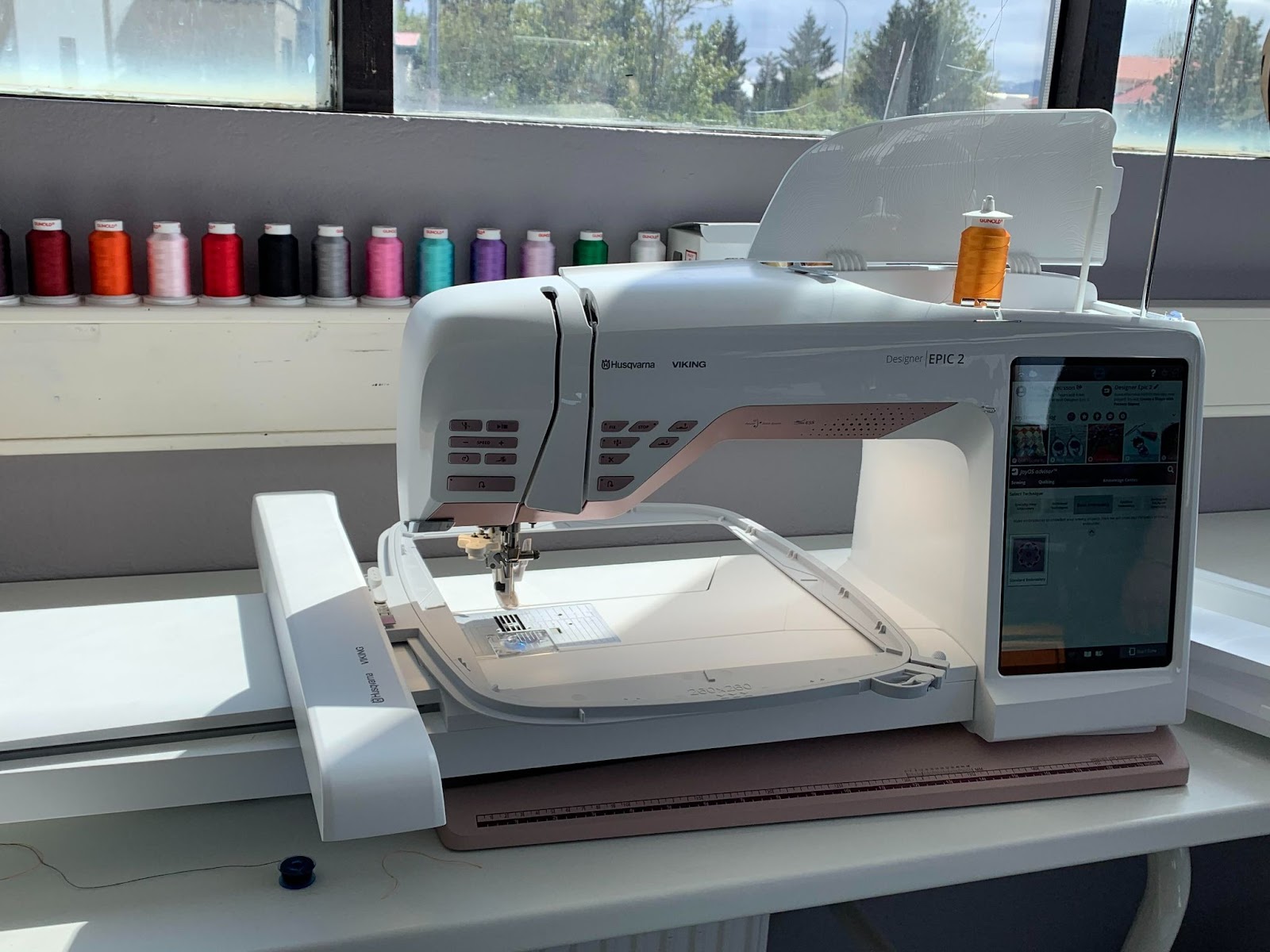
We’ve been learning several techniques to manipulate and unlock the potentials within fibre practices, such as tapestry weaving, wool spinning, and natural dyeing. I’m sure these will be elaborated on in future posts, but what felt like a turning point for me was the introduction to the TextileLab. Laser cutting, tufting, 3D printing, machine felting – all of these often-elusive processes were readily available to us thanks to the efforts of the Textílmiðstöð Íslands staff. But to me, the crown jewel was the digital embroidery machine.
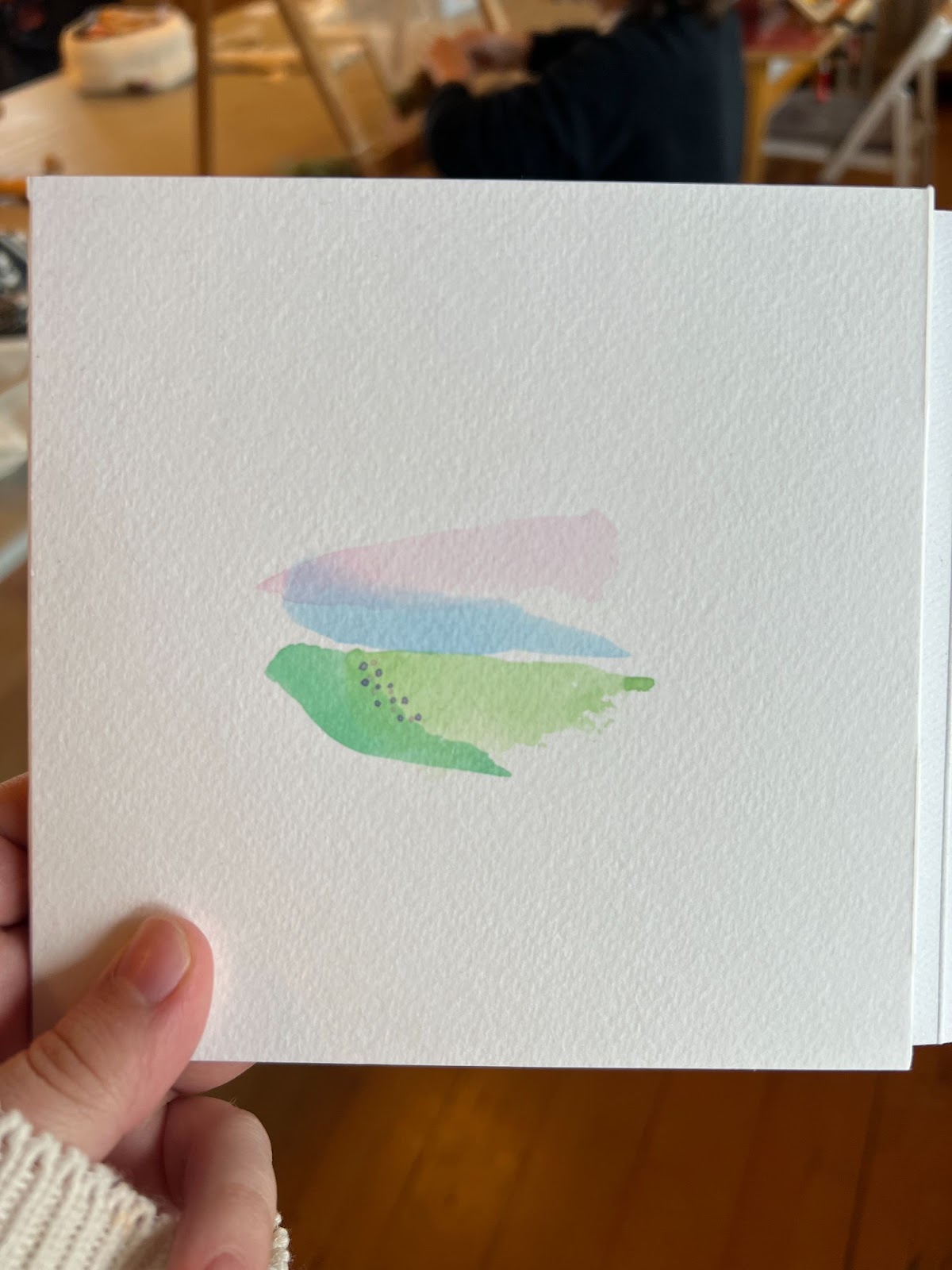
I am always looking for connections between my painting and textile practices. This machine seemed like a perfect opportunity to not only learn a new skill, but to imagine these connections in new and exciting ways. With the help of TextileLab manager Margrét Katrín, I was soon learning all the steps and features of the machine – and all of its peculiarities! My idea was to upload a photo of a watercolour painting I had done while here in Blönduós, and have the machine embroider it so I have two versions of the same image. But after selecting my photo (below), I quickly realized I was missing some crucial steps!
When attempting to digitize my image into an embroidery pattern, the software was unable to isolate sections of the painting due to the colours being too light, and too similar in value. There was also a lot of background “noise” and texture from the watercolour paper, and it would have taken hours of editing and manual selection to make the file legible to begin stitching. So instead, I created a new, digital version of my painting in Procreate. I imported a photo of my original watercolour as a semi-transparent layer, and traced the key elements to create a newer, more solid version:
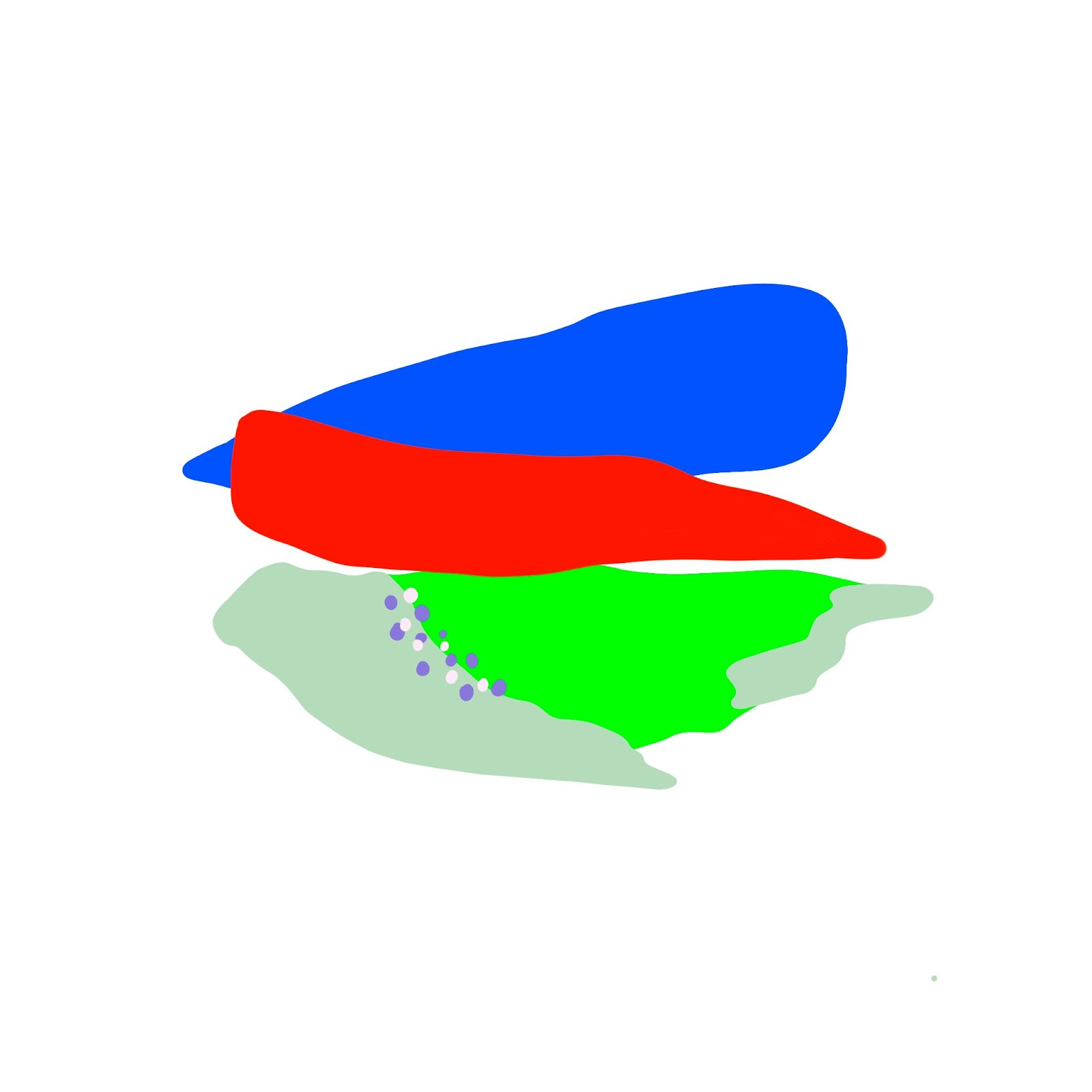
With this new version complete, I uploaded it to the embroidery machine and tried again. However, we soon discovered a new issue: my palette was still too light, and similar in value for the machine to clearly distinguish the sections. Margrét suggested I make another quick version, but choose extremely contrasting colours in the image. This was the result:
While this looks nothing like what I’d choose, and bears little resemblance to the original painting, it was a necessary step in order to allow the machine to create a pattern and embroider my design. And it worked like a charm! Before I knew it, the machine had started working away on the first green section.
But of course, there was one more thing I needed to keep in mind. As you can see from the latest digital version, the vibrant colours aren’t what I intended. Thankfully we managed to find an easy solution.
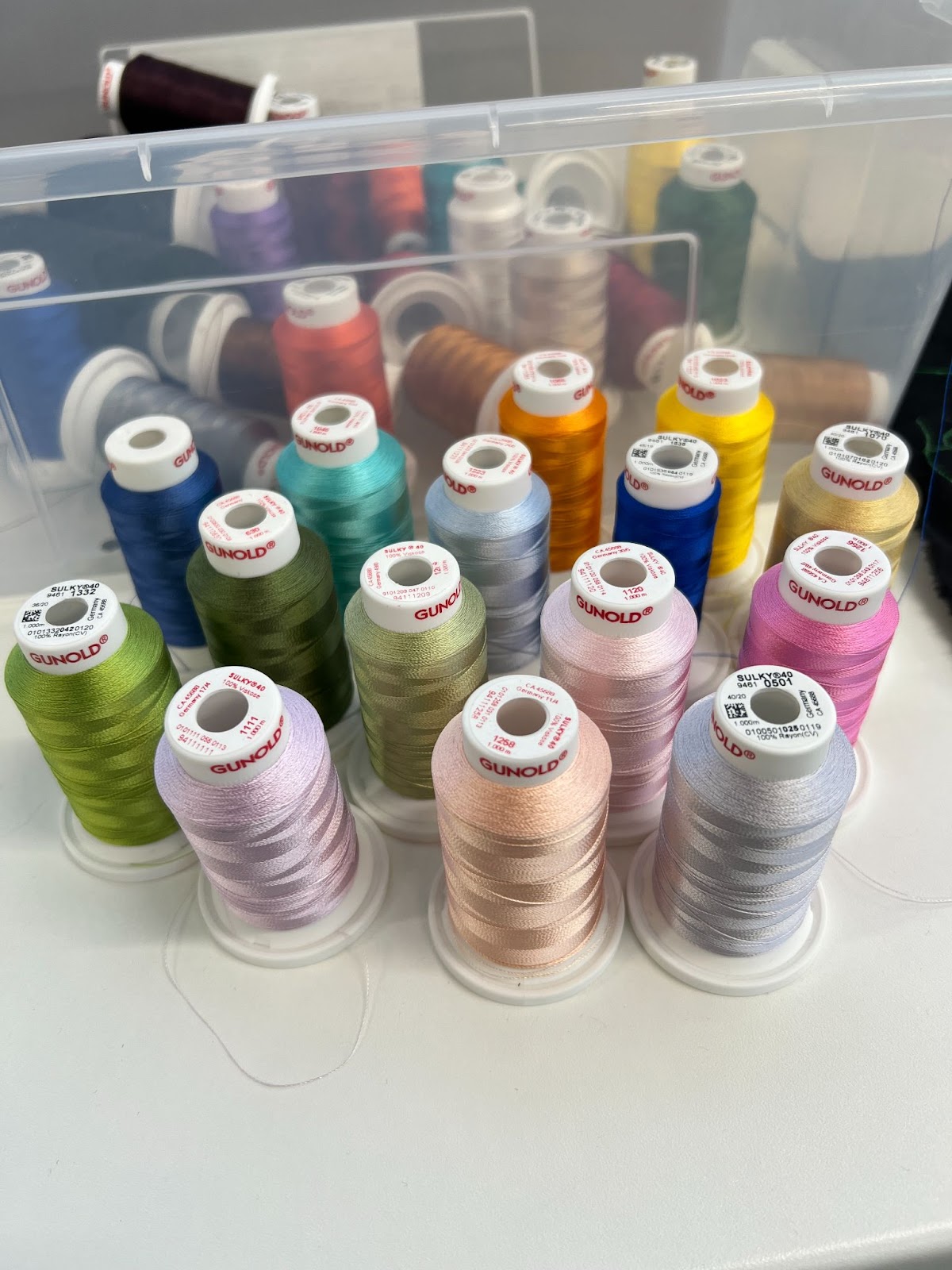
The trick was to know what each colour was supposed to be in the original, and to pick the correct colour thread when the machine prompted me to. For example, when the machine told me to load in the bright red colour in the centre of the piece, I instead threaded through a pale blue to match the original painting. I was lucky that the TextileLab had a fair selection of colours, and my usual pastel palette was almost entirely available to use!
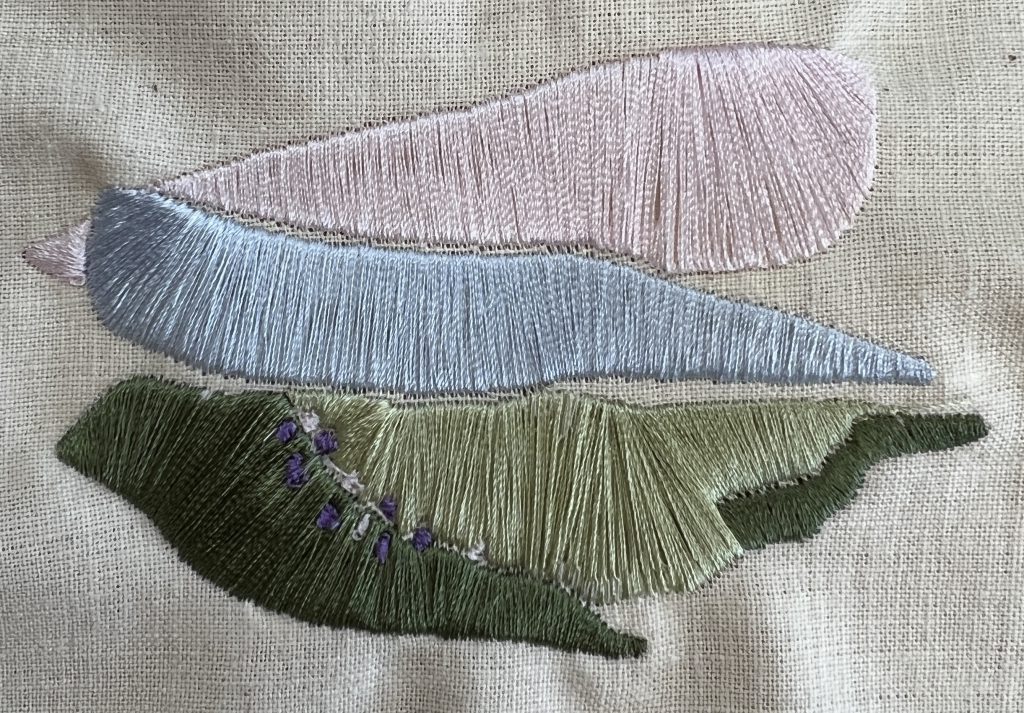
After some careful colour picking, the process went quite quickly. Each section took less than 5 minutes, and the switching of the thread became almost reflexive, and meditative. After about 20 minutes of waiting and swapping colours, I was left with this beautiful finished piece!
Not bad for a first attempt! Margrét and I looked closely at the work to determine ways we could improve next time, such as tightening the original placement of the cloth to avoid puckering, and overlapping the colours slightly in the design software to avoid small gaps between sections.
Overall, I’m very pleased with this piece and I’m even more excited to make more! In my work, I often explore methods of working and re-working materials as ongoing investigations into their individual and collective potentials – that is to say, I like to experiment with new techniques, and push the limits of what we think a medium or material is meant to be. The TextileLab is an incredible resource for artists, both visiting and local, to have fun and see for themselves the potential locked within each piece of equipment, and within their own work. Needless to say, I’ll be back to do more work very soon!
Daniel Rumbolt (he/him) Student, MFA Fibres and Material Practices
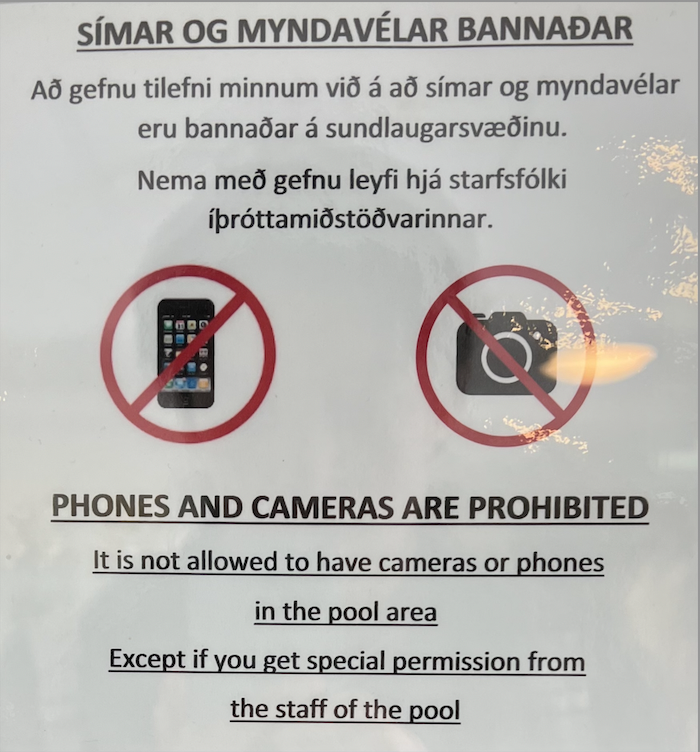
It’s been 14 days since I’ve been situated in Iceland and I don’t think I’ll ever get used to the landscape, sunsets, and the wildlife it offers. I catch myself trying to document the beauty with my camera even though I know it’s impossible, yet I still try. Right now, there are 923 photos and 161 videos on my phone. There is one place I’ve been desperately wanting to photograph but I am also aware that I can’t and it will not do it justice. You might think it’s the looming mountains, the majestic horses flocking in the field or even the light that makes time seem frozen. Those are all true but the Blönduós pool in the Sports Centre is what I’m talking about.
Prior to this experience, Kathleen mentioned the pool and the sense of community it offers to all the residents in Blönduós, especially the older folks. I was excited that a pool exists, and it was a place to relax and (maybe) get my exercise. I was also very intrigued about the coffee/hot tub ritual which Google translates from Icelandic as “open, always hot in the jug”. However, I didn’t put too much thought into it.
Now fast forward to my arrival in Iceland
I had a short end of the stick coming to Blönduós as my flight was delayed and a series of unfortunate events came after. Luckily the environment and the positive vibes from the cohort immediately evaporated my negative feelings. I was touched by gestures of warm hugs and smiling faces as the class met me at the gas station. I noticed a kind and relaxing energy exulting from the group, and some seem to have damp and wet hair from the pool. I was excited to finally arrive, and even though it was difficult to settle down with all that excitement, I eventually did. The next morning, I felt that same kind and relaxing energy but this time everyone was raving about this magical pool. I was hesitant about everyone’s reviews, but I knew the best way was to try it myself. Ever since that first time, I swear I have never looked back. In an unexpected way, the pool has become part of my rhythm and routine of some sort. I use the sauna as a mediative space and many of my thoughts on my art-making process have been found there. The hot pool is where I socialize and say hello to friendly strangers from Iceland or other visiting members. By now I think this is the part where I give a comprehensive description of my transformative experience, but words can’t do it justice just like a photo. The best way I can elaborate is to see you there!
Hot tip: you need to always finish off with the 5 degrees tub (preferably 1 minute or more)
On June 7th, some Concordia students, my professor, Kathleen Vaughan and I attended a natural dyes workshop led by Guðrún Bjarnadóttir, an Icelandic natural dryer and author of Plants of Iceland – Traditional uses and folklore. She warmly greeted all of us at her plant dyeing at Árnes við Andakílsárvirkjun in Borgarnes where the workshop took place.
She put us into groups of twos and then conducted the workshop by first giving demonstrations (e.g. how to cut rhubarb). We then boiled plants as Gudrun gave instructions. She mentioned important rules about dyeing plants i.e. respect the plants, do not take too much; never use the dye pots for cooking food; use as little chemicals as possible. Gudrun is a hands-on workshop leader, very attentive and dynamic, moreover, she loves that her workshop participants learn by doing.
Dominique and I got spruce pine cones, which Gudrun boiled one night before the workshop as it needed more time (4-5 hours) to boil them. The second one that we boiled was rhubarb leaves. It took about an hour or so to boil them. Gudrun mentioned that using rhubarb for dyeing wool is not part of the Icelandic tradition. People imported rhubarb to Iceland as a food plant many centuries ago.
Spruce pine cones. Photo: Avy Loftus, 2018
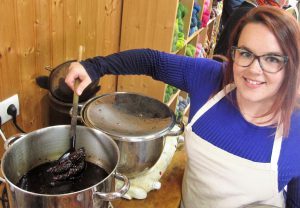
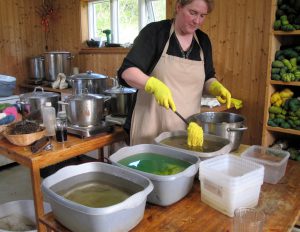
While waiting for the dyebath to be ready for dyeing, Gudrun offered us home-made food in her house. About one hour later, the dyes were ready and Gudrun took out yarn, which she had already soaked in alum overnight. The yarn was ready to be dyed and she chose white and grey wool (3 of each colour) to be dyed in the dye pots. We put the yarn in pots and waited for a while until the yarn soaked in the dyes.
In the meantime, she told us briefly about the history of plant dyeing in Iceland, icelandic plants she uses and mordants that are used to enhance the colours, such as alum, copper, creme de tartar, ammonium, chrome, iron, tin and vinegar. Copper, chrome and tin should not be used for more than sixty minutes with the yarn, and iron should not be used for more than fifteen minutes. In the old days, cow urine and human urine were used for mordant. Older urine was preferred as its pH level increased and it became more alkaline.
Gudrun, later on, prepared three dye baths for the yarn; alum, copper and ammonium, which all had strong odours. Then, she started putting the yarn into alum, copper and ammonium and asked us to track them all. Our rhubarb leaves gave a deep yellow colour, and with alum, they became bright yellow. The copper and ammonium resulted in a moss green colour.
Rhubarb leaves with alum, became bright yellow. Photo: Avy Loftus, 2018
Making dyes requires time, patience and energy, but the natural beauty of the colours as the result of the workshop was gratifying. Each plant provides an amazing diversity of shades which comes from Icelandic moss, lichen, lupin leaves, lupin flowers, heather, spruce pine cones, rhubarb leaves, rhubarb root, madder, birch, onion skin and cow parsley.
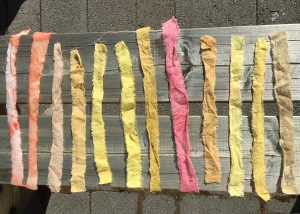
I dyed cotton and silk fabric into the dyebath that was used at the workshop. The results were different from the colours on wool. The colours used on cotton and silk ended up more pastel. Wool and silk have different fibre characteristics; therefore, the result was not the same. It is also impossible to obtain the same colour twice because of reasons such as the pH degree of soil and water, which can vary.
Pastel colours on silk and cotton. Photo: Hannah Grabowecky, 2018
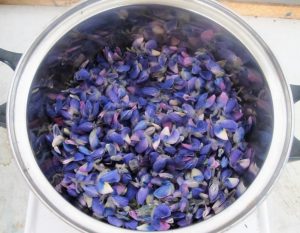
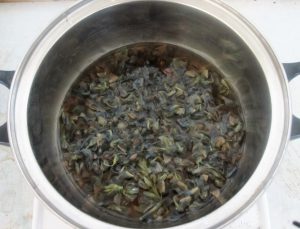
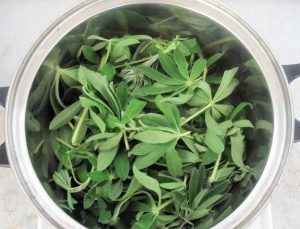
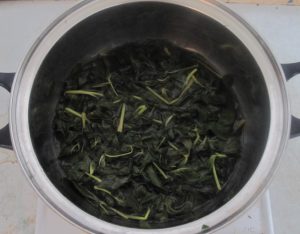
A week after the workshop, I started my natural dyes experiment from lupin flowers and leaves, using rain water and tap water. The variety of colours were produced as the result of my experiment. The dye from lupin flowers is usually greenish, but with alum as the mordant and rain water, it can be greyish. With vinegar as the mordant and rain water, it can be red purpleish. The dye from lupin leaves is usually yellow, but with mordant, it can be a deeper yellow shade.
Lupin flowers. Photo: Avy Loftus, 2018
Lupin flowers after one hour. Photo: Avy Loftus, 2018
Lupin leaves. Photo: Avy Loftus, 2018
Lupin leaves after one hour. Photo: Avy Loftus, 2018
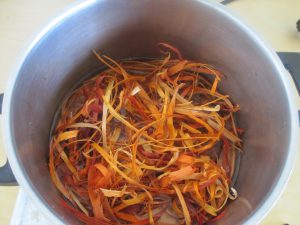
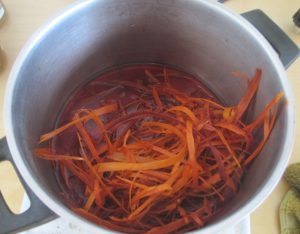
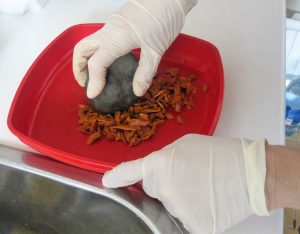
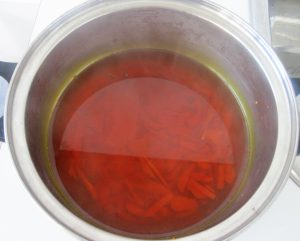
As Gudrun mentioned having difficulties with sappan wood to produce red, I investigated the sappan wood dyeing process with rain water and tap water separately. I found that using rain water to boil sappan wood produced a deeper, clearer red. On the other hand, using tap water produced a more orange colour. With alum as a mordant, it produced a deeper orange. It’s the same case for turmeric. Using rain water to boil the turmeric produced a deeper yellow, without any mordant. Meanwhile, using tap water to boil the turmeric, produces a lighter yellow and with alum as a mordant, it becomes a deeper yellow.
Sappan wood. Photo: Avy Loftus, 2018
Sappan wood with rain water. Photo: Avy Loftus, 2018
Tenderizing turmeric. Photo: Meghan Riley, 2018
Turmeric dye. Photo: Avy Loftus, 2018
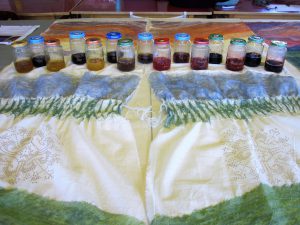
A dyer should aim to create new shades, rather than to duplicate others’ results. I created different shades of colours for my artwork and labeled them as follows: lupin leaves (with alum, rain water), lupin leaves (with alum, tap water), lupin leaves (with vinegar, rain water), lupin flowers (with alum, rain water), lupin flowers (with alum, tap water), lupin flowers (with vinegar, rain water), sappan wood (without mordant, tap water), sappan wood (without mordant, rain water), sappan wood (with alum, tap water), sappan wood (with vinegar, rain water), turmeric (with alum, tap water), turmeric (with alum, rain water), indigo + turmeric (with alum, tap water), indigo + lupin leaves (with alum, rain water), sappan wood (with alum, rain water) + lupin leaves (with alum, rain water), sappan wood (with alum, rain water) + indigo.
Different shades of colours for painting. Photo: Avy Loftus, 2018
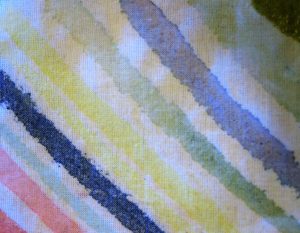
Different shades of colours on cotton. Photo: Avy Loftus, 2018
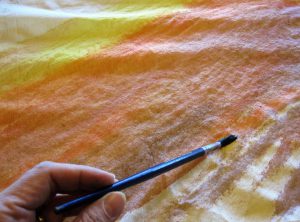
Layers of colours from lupin leaves, turmeric and sappan wood dyes. Photo: Avy Loftus, 2018
Layers of colours from lupin leaves, turmeric dyes and a little bit of indigo. Photo: Avy Loftus, 2018
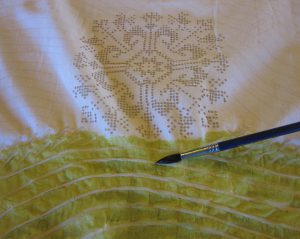
Icelandic motif, using sappan wood and indigo. Photo: Avy Loftus, 2018
All natural colours produced at the dye studio were applied on these paintings. Photo: Avy Loftus, 2018
Plant dyeing deeply resonates with one’s view towards colours. A dyer or an artist cannot guess the exact shade that will be produced through plant dyes but the uncertainty is a key part of the experience. The variables involved make dyeing exciting, as each project will result in new shades and tones. In the end, plant dyeing is gratifying and the end result makes the whole process worthwhile.
I am now back home, in very hot Montreal. A harsh contrast, to the weather I have been experiencing in Iceland, for the pas month. Hopefully, I will find a suitable pool to help with the transition. Sitting on my balcony, it’s 6am and I am reflecting on the past month. I’m realizing how much music has been a part of my journey. I haven’t read any of the books I brought, but I listened to music everyday; matching moods, matching feelings.
I created a short mixtape that illustrates my time in Iceland; linking them to some of my experiences.
Arriving in Iceland, the plane coming through the clouds and preparing for landing. Realizing it is raining and seeing for the first time, the beautiful colours of the landscape.
The first song to play on my Spotify, when settling for my first night at the residence. I was feeling very much out of place. I sang this song during walks and the pool. I was my first inspiration to work with oranges for my project.
NOTE: The photos in this post are stereoscopic and can be viewed in 3D by crossing one’s eyes to merge the two photos together into a central 3D image. For more information on stereoscopic photography follow this link.
There are more sheep than humans in the West Fjords and they are wild on the land from June until September. Photo: Meghan Riley 2018
Photos often flatten the landscape and shrink the majestic. The other night after the sun had set and was starting to rise again in the northwest, I looked to the east and saw a very large and round silver-golden moon rising in a pink sky above a purple cloud. The moment was fleeting as the purple wisps of the cloud soon knit a curtain for the moon to hide behind. While the moon could still be seen, I sat in awe and shrugged off the urge to grab my phone to take a picture. Some beauty cannot be captured.
Though I often do try.
Clouds blanketing the sea in the West Fjords. Photo: Meghan Riley 2018
Sunset at the top of the fjord while camping in Heydalur. Not long before sunrise. Photo: Meghan Riley 2018
A trip through the West Fjords, I exhausted myself taking photos. What is this urge to capture and collect?
Mountains and sky, snow and ice, birds and sheep, moss and…
Flower embroidery on gravel. Drangajökull Photo: Meghan Riley 2018
Drangajökull glacier under blue sky. Photo: Meghan Riley 2018
Meadow rock in Heydalur. Photo: Meghan RIley 2018
Heydalur Photo: Meghan Riley 2018
We spotted steam rising from the ocean as we approached Reykanes. Photo: Meghan Riley 2018
Reykanes Photo: Meghan Riley 2018
Reykanes Photo: Meghan Riley 2018
Valley at Drangajökull glacier. 9pm Photo: Meghan Riley 2018
It is all very beautiful: Looking far and wide across the fjords or close to the etchings of lichen on a rock. My senses are together braiding my experience, reaching out all around me to take it in.
Bird song, gurgling water, wind, the smell of snow…
Bird song. Heydalur Photo: Meghan Riley 2018
The smell of snow and sunshine. Photo: Meghan Riley 2018
A photo will never fully capture any of this. But it is a trigger to remember these sensations; a doorway through which to someway return.
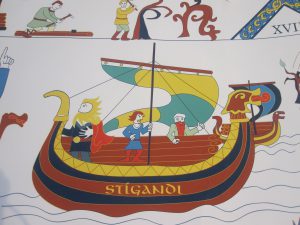
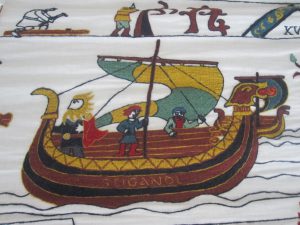
The idea ofVatnsdæla on a tapestry was born from the vision of Jóhanna E. Pálmadóttir. She was inspired by the Bayeux tapestry, which was created approximately between 1066-1077 and recorded at a Cathedral in Northern France.
In the beginning of this wonderful project, Jóhanna collaborated with the second year students from the graphic design department at the Iceland University of the Arts in Reykjavik, who created the drawings of Vatnsdæla in 2011. They were under the supervision of Kristin Ragna Gunnarsdóttir, a graphic designer, illustrator, writer and teacher at that school. Helga, Jóhanna’s daughter helped with the process of pokingholes on the first drawing in order to transfer the images onto the tapestry. Later on, a group of students from Denmark volunteered to undertake poking holes in the rest of the drawings.
Part of the drawing. Photo: Avy Loftus, 2018
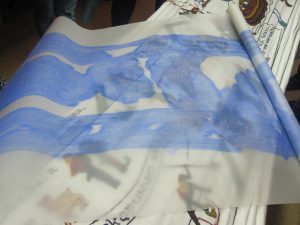
Transferring the drawing into a transparent paper and poking the holes into the tapestry. Photo: Avy Loftus, 2018
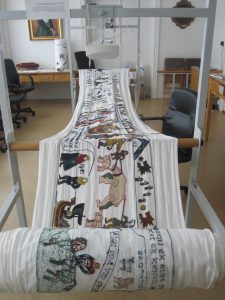
Part of the embroidery on the tapestry. Photo: Avy Loftus, 2018
The aim of this project is to revive the Vatnsdæla saga, an old story in Iceland, in a new, exciting way through a textile based community project. Jóhanna, who was on the board of Textilsetur Islands at that time, also collaborated with Landnám Ingimundar gamla, an association that assisted with the historic narrative of Vatnsdæla saga. The saga is the family history of the people of Hof, a farm in Vatnsdalur, not far from Blönduós. It took place from 9th to 11th century and was written in 1270 AD. The story covers themes such as love, fate, honour, perseverance and valiance against enemies.
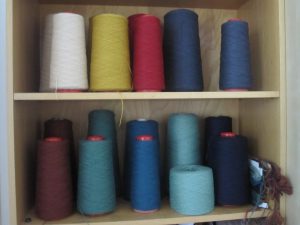
Colourful yard used for the embroidery. Photo: Avy Loftus, 2018
Jóhanna purchased the yarn for the tapestry from Ístex hf, a spinning mill that produced the yarn from lambs’ wool. The ancient embroidery, which existed in the middle age in Iceland, is introduced again through Vatnsdæla on a tapestry project. The tapestry will be 46 metres long and the names of all those supported this project will get their names in a book which will be displayed alongside the completed tapestry. People can support this project through purchasing an embroidery lesson on site or through donations.
Vatnsdæla on a tapestry at Kvennaskolinn. Photo: Avy Loftus, 2018
Jóhanna’s vision is to exhibit the finished Vatnsdæla on a tapestry at a location in a farm land, where Þingeyrakirkja, an old stone church, is located and the church was built in 1873. On this farm land, the first monastery in Iceland was built in 1133.
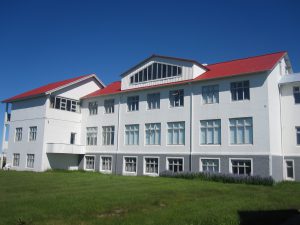
The location of Vatnsdæla on a tapestry is now in Kvennaskólinn, the former women’s school in Blönduós. The opening hours are from 13:00 to 17:00 on weekdays from June 15th to August 15th. During winter months and weekends, the site is closed, however, group visits can be arranged.
Kvennaskólinn, the house for Vatnsdæla on a tapestry now. Photo: Avy Loftus, 2018
As an art therapist in training, I am continuously fascinated and amazed by how art has been used therapeutically throughout history. Even before the Creative Art Therapies was a field in its own right, drama, dance, music, poetry, and visual arts were used by humans as a means of expression and self-regulation (Malchiodi, 2007). Other research has demonstrated that textile art practices impart a considerable number of benefits to their makers (Futterman Collier, Wayment, & Birkett, 2016; Garlock, 2016; Homer, 2015; Pöllänen, 2015; Futterman Collier, 2011). With one year of specialized education under my belt, and many more of clinical and community experience, I came to Iceland with the intention of investigating the relationship between art and mental health in a country with such rich traditional textile practices. In addition, I wanted to learn how men have been implicated in these traditions as literature on the use of textiles with male participants is virtually non-existent.
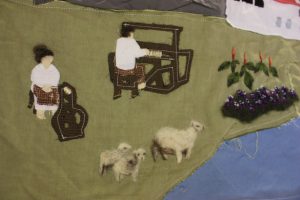
Throughout my month-long stay in Blönduós, I spoke with local textile artists as well as those traveling from other parts of the world to attempt to narrow in on Iceland’s specific approach. According to the attendants I spoke with at the Textile Museum, knitting and sewing are taught in school at a young age, so children will learn some basic textile techniques regardless of gender or whether the information had been passed down from previous generations. In their cases, both young women had learnt knitting and quilting, among other skills, from their respective grandmothers. This was a pleasant surprise for me, as my Canadian experience of textile work started and almost ended in grade nine home economics class which was entirely populated by girls.
A woman and man creating together. Detail from Collective Threads: An Icelandic Story. Photo: Hannah Grabowecky
They explained that although men don’t seem to carry on the fibre traditions in the same way that women continue to do, in the days of Halldóra Bjarnadóttir – a teacher, activist, and textile enthusiast born in 1873 – women spun the yarn to be woven by men into fabric (personal communication, June 12, 2018). At the time, these roles were in place as weaving was considered tough labour while spinning required more finesse. When asked if they would likely pass their knowledge of fibres onto future generations, both attendants chuckled and replied no, rationalizing that they simply weren’t “good enough” to teach others.
I also spoke with two textile artists from the UK, Deborah Gray, who is participating in a two-month residency at the Textile Centre in Blönduós, and Louise Harris, who moved from England to Iceland 12 years prior and is currently working in Reykjavik. Deborah has been a practicing fibre artist for the past 40 years, teaching her craft to others for the past 35. Still today she uses knitting daily to unwind, claiming “I don’t know how people cope who don’t have some sort of creative practice” (personal communication, June 3, 2018). Louise’s current work incorporates the process-heavy nature of felting, a technique which she has adopted as an everyday activity. She explained that during her time at Goldsmiths University in London, she used textiles in conjunction with painting in an attempt to disrupt the male-dominated contemporary field of painting.
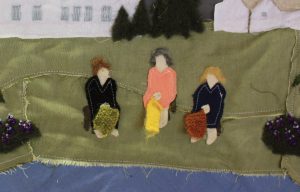
Again, the role of gender in the art world came up in conversation with Hannele Hentinnen who led a workshop on advanced knitting. She posed the question to our group, “why is it that men come into this female-dominated field and make such waves?”, giving the examples of American fibre artists Kaffe Fassett and Stephen West. One explanation she offered was that since men don’t have as long of a textile history as women, the ideas they bring to the table are more fresh and innovative. This got me thinking, “are men the future of fibre art?” If women, such as the attendants at the Textile Museum, do not perpetuate the cycle of teaching to their female offspring, perhaps there will be a more even playing field for all genders.
Social knitting. Detail from Collective Threads: An Icelandic Story. Photo: Hannah Grabowecky
Returning to the topic of textile creation and mental health, I had the pleasure of attending a talk by psychologist and editor, Kristín Linda Jónsdóttir, with the opportunity to pick her brain following the presentation. She shared her research relating knitting to happiness and achieving a state of “flow”, a combination of rhythmic creation with just the right amount of cognitive challenge (personal communication, June 8, 2018). This concept has appeared in my research as well, and it felt validating to hear that similar benefits have been found in Icelandic studies. This information was another reassurance that people are acknowledging and understanding the positive psychological effects of art making, leading me to believe that textile handcrafts will continue to be practiced for many years to come.
References
Futterman Collier, A. (2011). The well-being of women who create with textiles: Implications for art therapy. Art Therapy:Journal of the American Art Therapy Association, 28(3), 104-112. doi:10.1080/07421656.2011.597025
Futterman Collier, A. D., Wayment, H. A. & Birkett, M. (2016). Impact of making textile handcrafts on mood enhancement and inflammatory immune changes. Art Therapy:Journal of the American Art Therapy Association, 33(4), 178-185. doi:10.1080/07421656.2016.1226647
Garlock, L. R. (2016). Stories in the cloth: Art therapy and narrative textiles. Art Therapy:Journal of the American Art Therapy Association, 33(2), 58-66. doi:10.1080/07421656.2016.1164004
Homer, E. S. (2015). Piece work: Fabric collage as a neurodevelopmental approach to trauma treatment. Art Therapy:Journal of the American Art Therapy Association, 32(1), 20-26. doi:10.1080/07421656.2015.992824
Malchiodi, C. A. (2007). What is art therapy? In C. A. Malchiodi (Eds.), The art therapy sourcebook (2nd ed., pp. 1-22). New York: McGraw-Hill.
Pöllänen, S. (2015). Elements of crafts that enhance well-being: Textile craft makers’ descriptions of their leisure activity. Journal of Leisure Research, 47(1), 58-78. Retrieved from https://0-www-scopus-com.mercury.concordia.ca/record/display.uri?eid=2-s2.0-84920396481&origin=inward&txGid=f896b8b82c8fbe9f9db044f586f768be